Best Secret Santa Generators (2026): Free Tools Compared
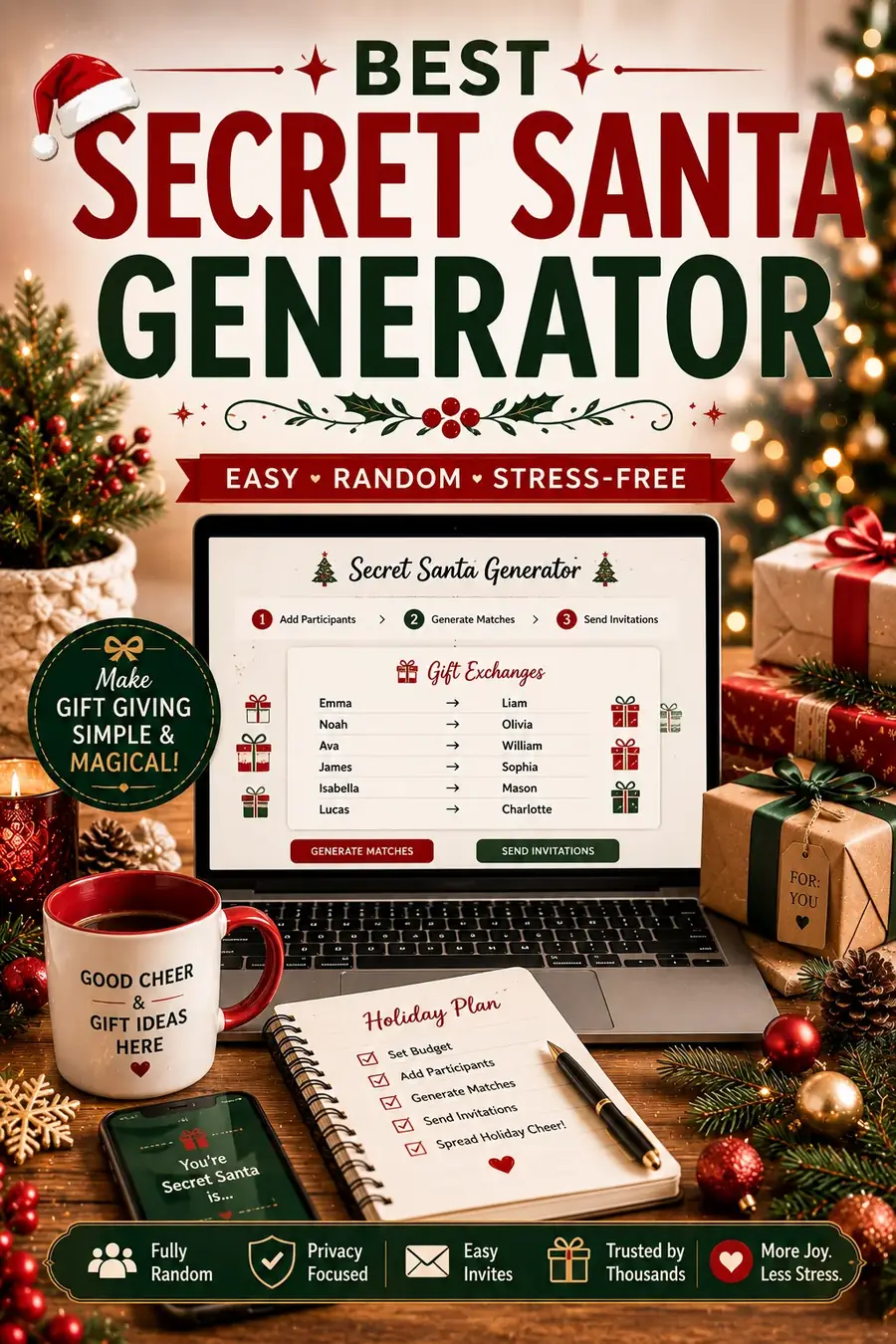
Every December, someone in your group volunteers to organize the gift exchange, and about four minutes later they're searching for the best Secret Santa generator because doing it by hand turned out to be harder than it looked. Nine people, three couples who shouldn't draw each other, two who live in another state, and one who keeps asking what the budget is.
A good generator solves all of that in a couple of minutes. A bad one asks everyone to make an account first, and half your group quietly never signs up.
This guide covers what actually matters when you're choosing a tool, an honest look at every method people use — including the ones that don't involve software at all — and how to run the draw so it goes smoothly.
What Makes a Good Secret Santa Generator
Most tools do the basic thing fine: shuffle names, pair people up. The differences show up in the details, and the details are what make or break your December.
No account required
This is the big one. Every extra step between "here's the link" and "I know who I have" costs you participants. If your group has to register, confirm an email, and set a password before they can see a name, someone will stall for a week and you'll be chasing them. The best tools let people join with a name and, at most, an email address.
Exclusion rules
The feature people don't know they need until the draw pairs a married couple together. Exclusions let you say "Sam can't draw Alex" and "the twins can't draw each other," and the tool works around it. Without this, you're re-running the draw until it happens to work, and every re-run is a chance for someone to see something they shouldn't.
Good exclusion handling also tells you when your rules are impossible — if you've blocked so many pairings that no valid arrangement exists, the tool should say so instead of spinning forever.
Wishlists
Wishlists quietly fix the biggest complaint about Secret Santa: getting a gift that misses. When each person can add three or four things they'd actually like, the giver has somewhere to start and the recipient gets something useful. It doesn't kill the surprise — the giver still chooses, and can go off-list entirely.
Email or share-link delivery
Your group needs to receive their assignment without the organizer reading it. Two approaches work: emailing each person their match directly, or generating private reveal links that each person opens on their own. Both keep the organizer out of it. What doesn't work is the organizer texting everyone individually, which means one person knows the whole map.
Works properly on a phone
Most people will open their assignment on a phone, standing in a kitchen, with about eleven seconds of attention. If the tool needs pinching and zooming, or the reveal button sits off-screen, you'll get "it didn't work" messages. Test the link on your own phone before you send it out.
Privacy you can explain
If someone asks what happens to their email address, you want a straight answer. Prefer tools that collect the minimum, don't require accounts, and don't sell or share participant data. A gift exchange is not worth handing over a group's contact list to a marketing database.
The Tools Compared
There are really four ways people run a name draw. Each one genuinely works for some groups and genuinely fails for others.
Online generators
The default choice for good reason. You enter names, set exclusions, and the tool does the draw and delivers each assignment privately. The whole thing takes a couple of minutes and works whether your group is in one room or five time zones.
Best for: remote groups, big groups, families with couples, anyone who wants wishlists.
Watch for: tools that require every participant to register, hide exclusions behind a paid tier, or bury you in upsells. Also check that the organizer can participate — some setups accidentally show the organizer everything.
Drawing names from a hat
Still the warmest version if everyone is physically in the room. There's something genuinely nice about the shuffle and the reach-in, and it costs nothing.
Best for: small in-person groups with no exclusion headaches.
Watch for: three real problems. Someone draws their own name and you restart. The organizer, holding the hat and watching faces, ends up knowing more than they should. And it simply doesn't work for anyone who isn't in the room, which usually means the cousin who moved away gets left out or handled separately, badly.
Spreadsheet or random shuffle
The DIY option: paste names into a spreadsheet, add a random column, sort, and pair each row with the next. It's free and it works — technically.
Best for: people who genuinely enjoy spreadsheets.
Watch for: it's fiddly and error-prone. You have to check manually that nobody drew themselves, exclusions require doing the puzzle in your head, and worst of all, you see every pairing. If you're participating too, your own surprise is gone. Fixing a mistake means redoing the whole grid and re-sending everything.
App-based options
Some tools ship as a downloadable app rather than a website. The upside is push notifications and a tidy interface for the reminders, budget, and event date.
Best for: groups that run a long exchange with reminders over several weeks.
Watch for: the install requirement is the same friction as an account requirement, doubled. Everyone has to download something, on the right platform, and one person always has the phone that can't. For a once-a-year draw, a web page is usually the lower-friction answer.
Our Generator
We built the tool on this site because we kept running into the same annoyances: sign-up walls, exclusions locked behind a paid plan, and draws that couldn't be fixed once someone dropped out.
It's free, and it works like this. You add your group, set any pairs who shouldn't draw each other, and hit draw. Assignments go out instantly — each person gets a private link that reveals only their own match, so you can organize the exchange and still be surprised by your own gift. Nobody makes an account. Participants can add a short wishlist if they want one, and skip it if they don't.
That's the whole thing. It isn't the only decent tool out there, and if something else fits your group better, use that instead. But if you want to draw names in the next two minutes without handing over anyone's details, start a draw here and you'll be done before the group chat catches up.
How to Run the Draw (Step by Step)
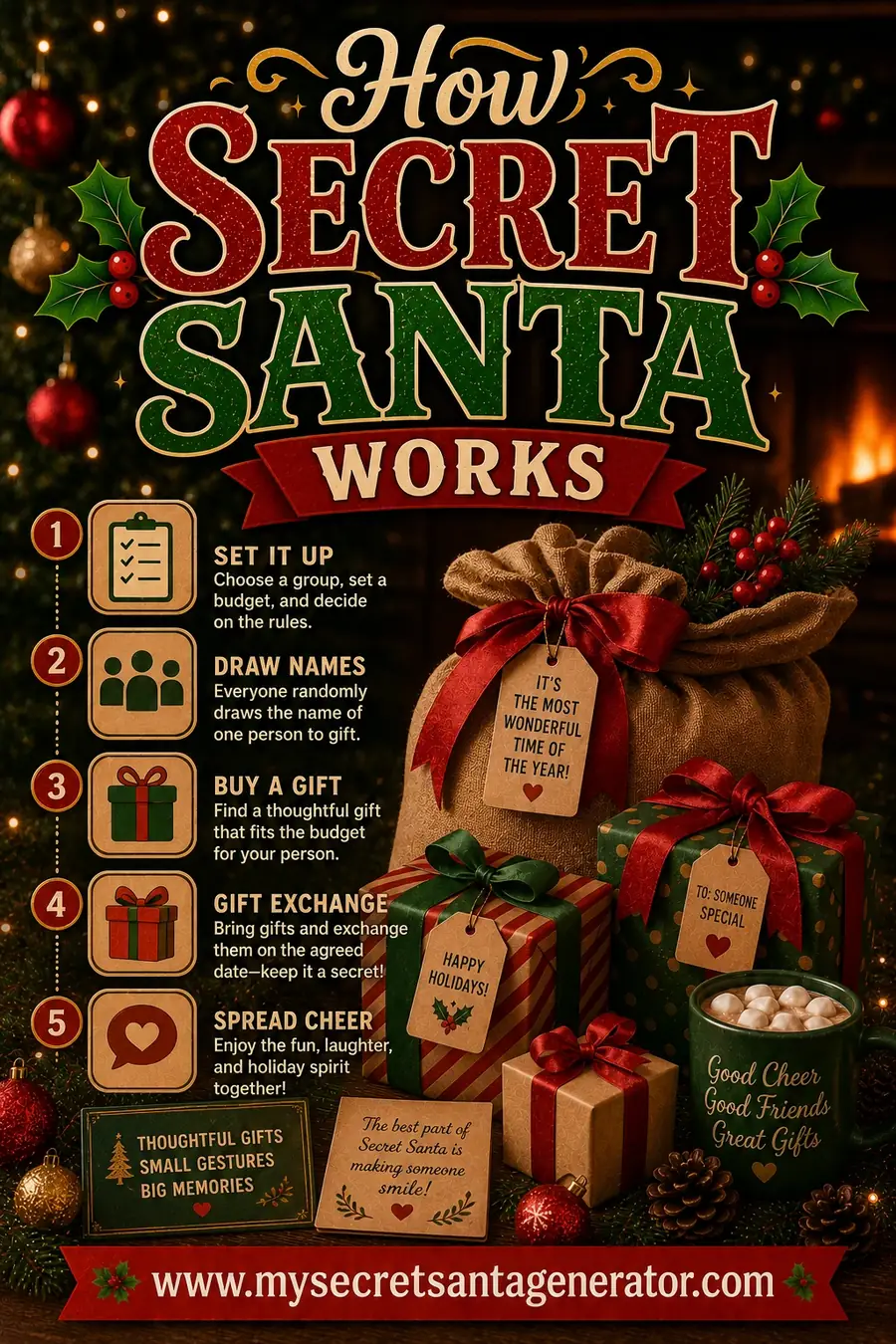
- Collect names and emails first. Do this in the group chat before you touch any tool. Chasing a missing email address halfway through the setup is what turns a two-minute job into a two-day one.
- Agree on the budget and the date. Settle both before the draw, not after. "Around $25" and "we open them on the 20th" are enough — vagueness here is where the awkward gift gaps come from.
- Set your exclusions. List every pair who shouldn't be matched: couples, siblings who already exchange separately, anyone who had each other last year if your group tracks that.
- Run the draw and send assignments. Use emailed matches or private reveal links so no single person sees the full map. If you're participating, don't peek at the results screen.
- Send one reminder. A week before the exchange date, post the budget and date again in the group chat. That single message prevents most of the last-minute panic buying.
Common Problems and Fixes
Someone didn't get their email. Check spam first — that's where it is roughly nine times out of ten. If it's genuinely missing, don't re-run the draw; resend that one person's assignment or send them their private link directly. A re-draw punishes everyone for one bad inbox.
A couple drew each other. This means exclusions weren't set, so you'll need a fresh draw. Add the exclusion rules, re-run, and tell the group plainly that the first draw is void and to ignore it. People are fine with a do-over if you say so clearly — what causes confusion is a silent second email.
Someone dropped out. If they hadn't bought anything yet, re-draw with the smaller list. If gifts are already purchased, the simpler fix is to have their giver pass that gift to whoever the dropout was assigned to, closing the loop by hand. Either works; pick the one that involves fewer messages.
You need to redo the draw without spoiling it. Run the new draw in a tool that reveals assignments privately, and send a short note: "Ignore the first message — here's the real one." Don't try to patch individual pairings by hand, because the person doing the patching sees too much and usually ends up spoiling their own surprise.
Frequently Asked Questions
Is it really free?
Ours is, with no trial period and no paid tier holding the useful features hostage. Other tools vary — some are free for small groups and charge above a certain size, and some put exclusions behind a paywall. Check before you invite people, because switching tools mid-setup is a headache.
Do participants need accounts?
Not with our generator. Everyone gets a private link, opens it, sees their match, and that's the whole interaction. Some tools do require registration, which is the single biggest reason organizers end up nagging their group in mid-December.
Can I stop couples drawing each other?
Yes — that's what exclusion rules are for. Add the pairs before you run the draw and the tool routes around them. If you set so many restrictions that no valid arrangement is possible, you'll be told, rather than left waiting.
What if someone joins late?
Easiest is to add them and re-draw before anyone has bought a gift, then tell the group the first assignments are void. If shopping has already started, add the newcomer manually to the end of the chain: they give to whoever was left without a giver, and receive from whoever needs a new recipient.
Pick the method that matches where your people actually are, set your exclusions before you draw, and agree on a budget in writing. That's genuinely most of it — the rest is just wrapping paper.