Dirty Santa Rules: How to Play the South's Favorite Holiday Game
Dirty Santa is what the Southeast United States calls the gift-stealing exchange the Northeast calls Yankee Swap and the rest of the country calls white elephant. The game is the same: numbered turns, open-or-steal, steal limits. What distinguishes Dirty Santa is the culture around it — more competitive, more theatrical, and more explicitly built around the drama of stealing from people you care about.
The "dirty" doesn't mean anything other than the delightfully rude act of taking someone's gift right out of their hands. Which is, of course, the entire point.
The Core Rules
Setup
Every participant brings one wrapped gift, valued at the agreed-upon budget (commonly $20–$30). Gifts go into a pile. No name tags.
Drawing Numbers
Everyone draws a number. The lower numbers go first; the last number has the strategic advantage.
Playing Your Turn
Number 1: Picks any wrapped gift from the pile, opens it.
Numbers 2 and onward: Each person can either:
- Take any unwrapped gift from the pile, open it, OR
- Steal any already-opened gift from another player
If your gift is stolen: You immediately pick an unwrapped gift from the pile. You cannot steal back the same gift that was just taken from you (it's protected for one round).
Dirty Santa Steal Rules
The most common Dirty Santa rule: three steals maximum per gift. Once a gift has been stolen three times, it is "frozen" permanently with whoever currently holds it.
Some groups play more aggressively with Dirty Santa compared to standard white elephant — using unlimited chains (where one steal can trigger a cascade of additional steals on the same turn) or allowing more than three total steals per item.
The End Game
After everyone has taken their turn, Player 1 has the option to steal any gift currently held by any player. This is Player 1's compensation for going first with no information. If Player 1 steals, the player whose gift was taken must open any remaining wrapped gifts.
Play continues until all wrapped gifts are open and all steal chains resolve.
How Dirty Santa Differs in Practice
While the mechanics are essentially identical to white elephant/Yankee Swap, Dirty Santa culture tends to emphasize:
The theater of the steal. In a classic Dirty Santa game, stealing is celebrated, not apologized for. The person who takes the most-wanted item with a deadpan expression and returns to their seat is playing the game right. The theatrical element is part of the appeal.
More competitive gifting. Because the culture around Dirty Santa is more explicitly about the game, people tend to bring gifts that create competition — desirable, high-quality items they know will be fought over.
Extended steal chains. Many Dirty Santa groups allow unlimited chains in a single turn: Player 5 steals from Player 2, which lets Player 2 steal from Player 1, which triggers Player 1's compensation pick. This creates more chaos and more turns per person.
The "don't freeze it" social pressure. In some Dirty Santa games, unfreezing a gift (by being the third steal) is a status move — whoever gets the item last is the "winner" of that particular steal war.
Popular Dirty Santa Variations
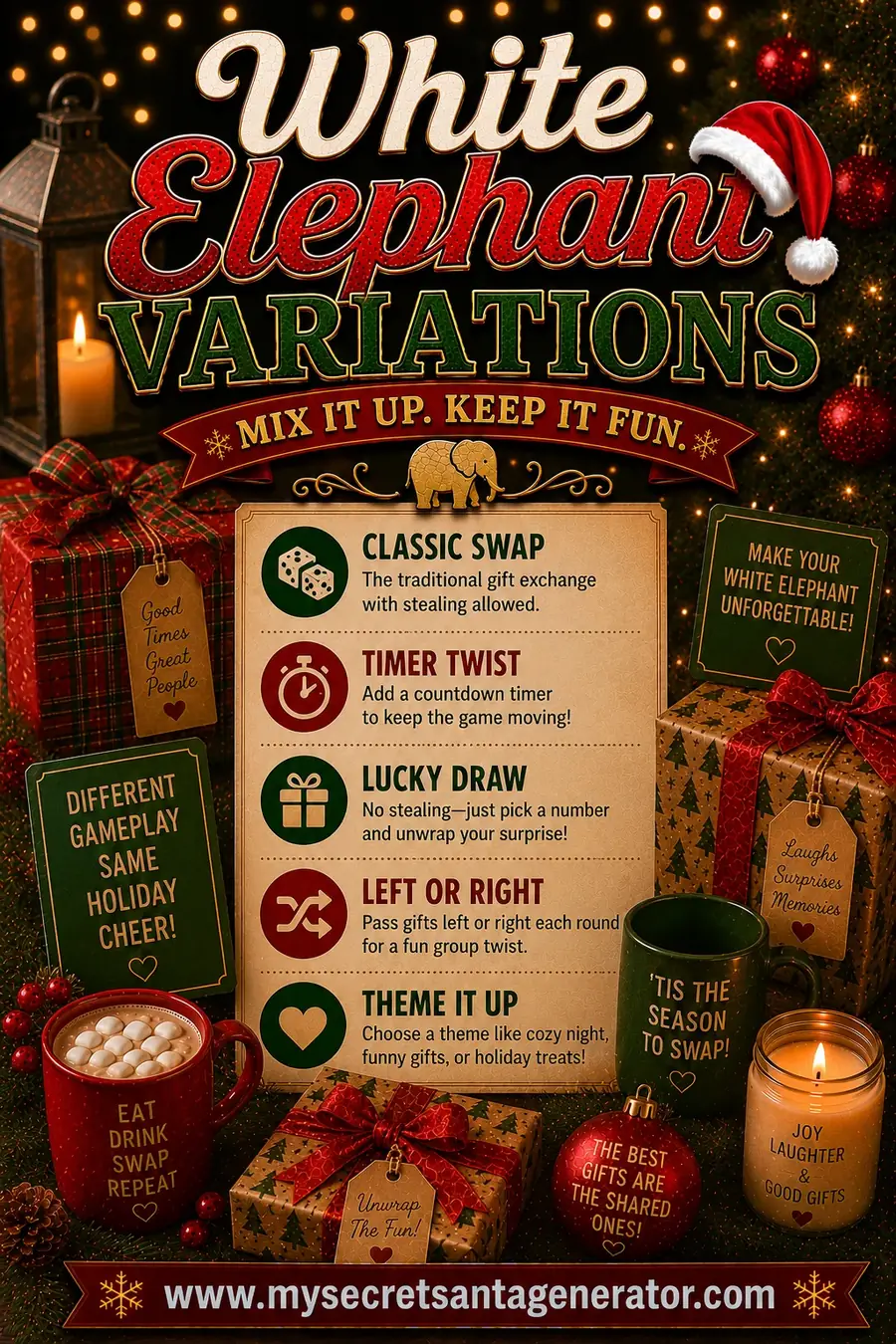
The Two-Steal Limit: Some groups use only two steals per gift for a shorter, cleaner game. Less chaos, faster resolution, better for groups with limited time.
Peek-a-Boo Dirty Santa: Some gifts are wrapped with a small visible hint on the outside (a ribbon color code, a partial label) that hints at the contents. Changes the strategy significantly — information before stealing.
Dirty Santa with a Theme: All gifts must fit a category — cooking items, outdoor gear, self-care, under $25 only. This tightens variance and ensures the game stays competitive rather than stratifying into "wanted" and "unwanted" piles.
The Reversal: After everyone has gone, the order reverses and everyone gets one more steal in reverse order. This dramatically extends the game but gives everyone two opportunities.
The Forced Swap: In some versions, a separate "swap" phase follows the stealing game — Player 1 can trade with Player 2, Player 2 can trade with Player 3, and so on in a final round of consensual exchanges. Less dramatic than stealing but creates more satisfaction in final outcomes.
The Best Gifts for Dirty Santa
Because Dirty Santa culture emphasizes competitive stealing, the best gifts are the ones that survive the full three-steal chain. That means: genuinely desirable, broadly appealing, and clearly quality.
What consistently gets stolen: Insulated tumblers (Stanley, Hydro Flask), quality candles from real brands, specialty food or drink sets, gift cards to universally loved places, quality board games.
What doesn't get stolen: Items only one person in the room would want, gag items with no real value beneath the joke, anything that looks or feels cheap.
Hosting Dirty Santa: Practical Preparation
A few things to prepare before the event that prevent the most common problems:
Communicate the rules in advance. The most common Dirty Santa dispute is over rules nobody agreed on beforehand. Send the rules when you invite people: steal limit, whether chains are allowed, what happens when the pile runs dry. A one-paragraph email prevents 80% of in-game arguments.
Print a visible rules card. Put the key rules on a card visible to the whole room during the game. Steal limit, frozen rules, end-game mechanic. Players forget rules under the excitement of wanting a specific gift.
Have a timekeeper. For groups prone to deliberation, a 30-60 second decision window keeps the game moving. The person who takes two minutes deciding whether to steal the candle is the reason the game runs 45 minutes longer than planned.
Designate the host. One person should run the game — calling turns, tracking the steal count on contested items, and resolving disputes. The host role prevents the game from stalling on procedural questions.
Prepare the number draw. Slips of paper in a hat works fine. A random number generator on your phone works fine. Just have something prepared rather than inventing the draw mechanism when everyone's already seated.
Have a backup rule for the empty pile. At some point the pile might empty during a steal chain. The most common fix: if your gift is stolen and the pile is empty, the game ends for you — you keep nothing or draw the final gift if any remain. Decide this in advance.
Frequently Asked Questions
What are the rules for Dirty Santa?
Everyone brings one wrapped gift. Players draw numbers for turn order. On your turn, open a new gift or steal an opened one. Stolen gifts are protected for one round. Maximum three steals per gift. Player 1 gets a final steal option after everyone has gone.
Is Dirty Santa the same as white elephant?
Yes — the same stealing gift exchange game with a regional name. "Dirty Santa" is common in the Southeast US; "white elephant" is more widespread nationally; "Yankee Swap" is used in the Northeast. The mechanics are essentially identical.
Why is it called Dirty Santa?
The "dirty" refers to the competitive stealing mechanic — the slightly rude act of taking a gift from someone who just opened it. It's a playful acknowledgment that the game involves deliberately taking things from people you like.
How many steals are allowed in Dirty Santa?
Most groups use three steals maximum per gift. Some Southern groups play more aggressively with unlimited steals or more steal chains per turn. Establish the limit before the game starts.
What's the best position in Dirty Santa?
The last position, by a significant margin. Full information, full choice. Player 1's compensation is the end-game steal option, which makes their position second-best overall.
What makes Dirty Santa different from regular white elephant?
Culturally more competitive and theatrical — the stealing is celebrated and the game leans into the dramatic element more explicitly. Mechanically very similar; the difference is in how groups approach and play the stealing aspect.