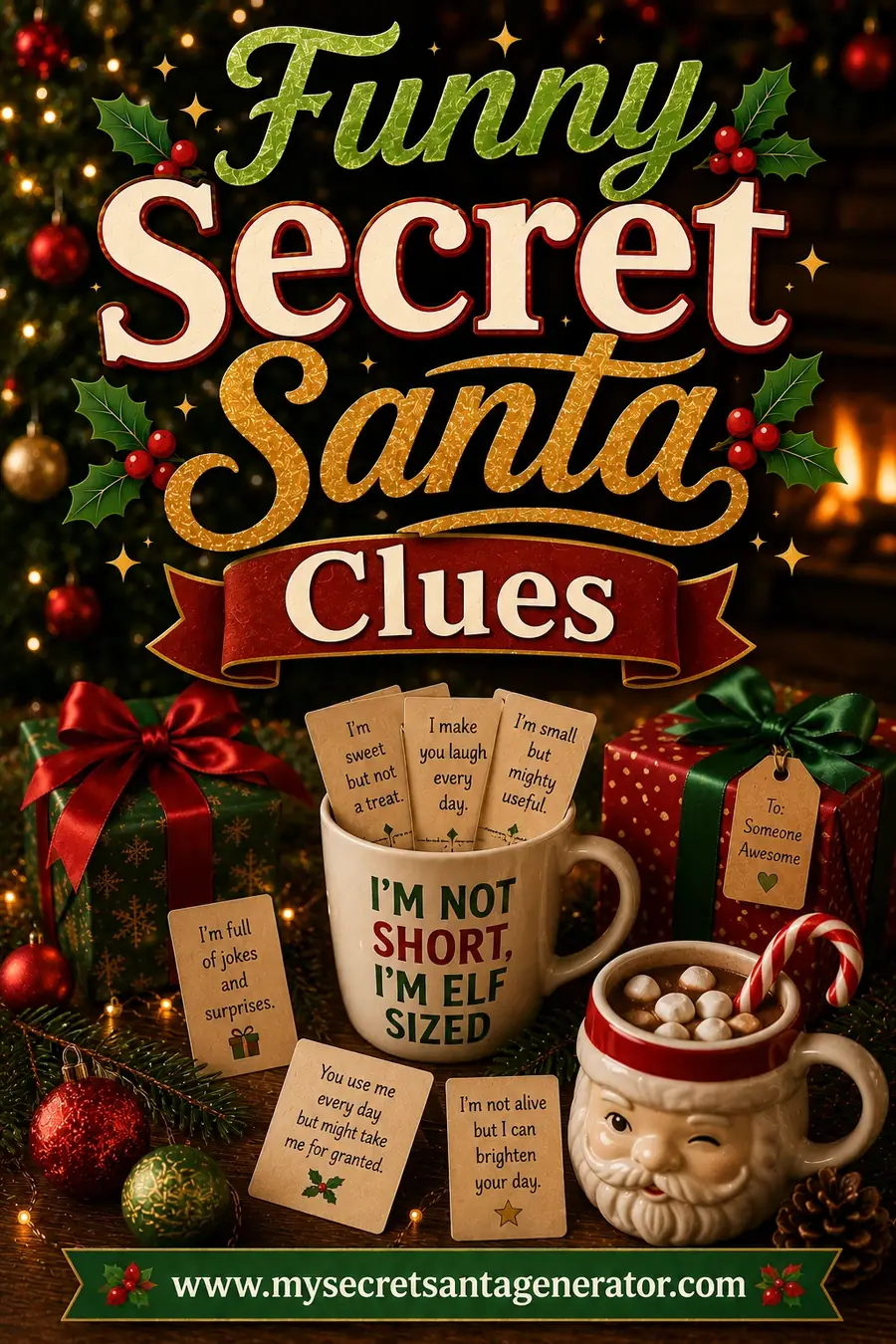
Funny Secret Santa Clues: Make Them Guess Before They Open
The funny clue is a specific genre. It's not a hint that happens to be humorous — it's a deliberate misdirection, technically accurate in every word and maximally misleading in every possible interpretation. Done well, the recipient reads it, guesses completely wrong, opens the gift, and immediately sees exactly how the clue was correct.
That gap — between the guess and the reveal — is the funniest moment in a Secret Santa exchange.
The Four Types of Funny Clue
1. The Technically Accurate But Useless Clue
Describes the gift in terms that are absolutely true and completely unhelpful.
"This object exists in three dimensions."
"It was manufactured at some point before today."
"It is not currently on fire."
"It has a weight measurable in standard units."
"At no point in its production was it involved in a significant geopolitical event."
These work as standalone clues or as warmup before a slightly more specific one.
2. The Deliberate Misdirection Clue
True statements that point confidently in the wrong direction.
"It's for your daily routine."
(The routine in question is sitting on the couch, not the morning workout they assumed you meant)
"This will change how you start your mornings."
(It's a better quality coffee mug — technically correct, extremely literal)
"It comes with instructions."
(Any product that comes with any kind of insert counts)
"Handle with care."
(This is a standard shipping instruction, but it sounds very ominous)
"This is not the last time you will need this."
(True of almost any consumable)
3. The Overly Serious Clue for a Ridiculous Gift
Applies the tone of a museum placard or official documentation to something absurd.
"A masterwork of [gift category] craftsmanship, this piece represents the pinnacle of human innovation in the [gift] space. Its acquisition was difficult; its quality is assured."
(For a $12 novelty item)
"This artifact has traveled far to reach you. Handle it accordingly."
(For a food gift from the supermarket in the next town)
"This item was selected after extensive research and careful deliberation. The findings are conclusive."
(For something you grabbed off a shelf in seven seconds)
4. The Personalized Misdirection Clue
Uses something specific about the recipient to create a more elaborate mislead.
For someone who loves coffee:
"I didn't get you coffee."
(Then you did get them coffee, or something coffee-adjacent)
For someone who mentioned they wanted a specific expensive thing:
"I got you something even better."
(Subjective claim that they can agree or disagree with upon opening)
For someone with a known strong opinion:
"I know you feel strongly about [topic].
This is the correct position on that topic, in gift form."
For someone who over-explains things:
"The explanation will be longer than the gift.
I have prepared remarks."
Funny Clues by Gift Category
For a Coffee Gift
"It's not a coffee maker. It's not a grinder. It's not a pour-over kit.
That's all I'll say."
(Then it's one of those things)
"Something that will improve the thing you already do too much of.
And you know exactly what I mean."
"I heard you complaining last Tuesday."
(Effective only if they did complain about their coffee situation)
For a Cozy Gift (Socks, Blanket, Slippers)
"This will make you harder to get off the couch.
I believe this is what you would have wanted."
"The world demands a lot of you.
This demands nothing."
"I considered your needs carefully.
Your primary need, as determined by observation, is this."
For a Food Gift
"Do not read the label before guessing.
The label will ruin the clue."
"It cannot be worn, it cannot be framed, it cannot be regifted without judgment.
These are features."
"This will be gone by February.
That's the goal."
The One-Word Clue
The ultimate minimalist funny clue. Give the recipient exactly one word — chosen to be either completely accurate and maximally confusing, or a word that applies to almost anything.
"Soft."
(For anything from a blanket to a food item to a book with a soft cover)
"Warm."
(Works for a coffee gift, a cozy item, a food gift, or anything you want to describe warmly)
"Necessary."
(Stakes the claim that the recipient needed this — leaves the definition of "necessary" completely open)
"Yours."
(Says nothing and somehow everything)
The one-word clue creates the longest guessing sequence and the most confused expressions. For groups that enjoy the extended game, it's the most entertaining option.
Escalating Clue Sequences
For groups that want extended anticipation, give three clues in sequence — each one slightly less misleading than the last. The escalation format maximizes the guessing window.
Round 1 (maximally useless):
"This object has a definite mass."
Round 2 (technically informative but still misleading):
"It is best used at a specific time of day, though not exclusively."
Round 3 (nearly revealing but still ambiguous):
"It involves something you put in your body. Or near your body. I'm saying no more."
The recipient guesses after each round. Correct guess ends the sequence; incorrect guess earns the next clue. The wrong guesses between rounds are often the funniest part.
Another escalating sequence for a cozy gift:
Round 1: "It cannot run, it cannot bark, it cannot complain."
(Ruling out animals and coworkers)
Round 2: "It works best when you have nowhere to be."
(Getting warmer)
Round 3: "December is its favorite season. Yours too, after this."
(The reveal is near)
The escalating sequence works especially well for groups that enjoy the game element and want the guessing to last longer than a single clue allows.
Writing Your Own Funny Clue
The formula for a good funny clue:
- Start with something true. A fact about the gift that's accurate.
- Remove any information that helps. Replace useful specifics with technically-true generalities.
- Add a confident tone. The more certain the clue sounds, the funnier the misdirection.
- End on something ambiguous. A statement that could mean anything — "you'll understand soon" — is a satisfying non-resolution.
Frequently Asked Questions
What makes a Secret Santa clue funny?
Technical accuracy combined with maximum misdirection. The clue is true in every word and completely unhelpful in every interpretation. The reveal shows the recipient exactly how the clue was correct — which is the satisfying punchline.
What's a good funny clue for a practical gift?
Apply excessive formality to the ordinary: "A masterwork of its category. Its acquisition was difficult. The quality is assured." The gap between the official tone and the $15 Amazon item is the joke.
Can a funny clue work for any gift?
Yes — the funny clue formula works for almost anything because it relies on misdirection rather than describing the gift. "This object exists in three dimensions" is technically true of every possible Secret Santa gift.
What if nobody gets the clue at all?
That's fine — often the funniest outcome. The recipient opens the gift, re-reads the clue, and the "oh, THAT'S what that meant" moment is its own satisfying punchline. Failed guesses are not a failed clue.
Should the clue be read aloud before opening?
Yes — always. The clue is a performance. The group guessing, the wrong answers, the confident wrong guesses, all of it only happens if the clue is shared before the wrapper comes off.
How do you keep a funny clue from being just confusing?
Make it technically accurate. Every word should be true of the gift — just true in a way that doesn't point to it. Random confusing statements that aren't about the gift aren't funny; technically accurate misdirection is.