Gift Exchange Games: Every Format Ranked and Explained

Secret Santa and white elephant are the two most commonly run gift exchange formats — but they're far from the only options. Some groups want more interactivity. Some want the gift to feel personal. Some want to run something nobody's done before.
This is every major gift exchange game worth considering, with honest notes on who each one is right for.
The Big Three: Core Formats
1. Secret Santa
How it works: Each person is secretly assigned one other person to buy for. Gifts are given individually, either by personal delivery, mail, or at a group reveal event.
Best for: Groups where people know each other reasonably well. Works at any size with digital tools (like a free Secret Santa generator). Produces the most personal, meaningful gifts.
Not ideal for: Large groups where many people don't know each other, or any situation where you need the gift exchange to also be the entertainment event.
Steal mechanic: None.
2. White Elephant / Yankee Swap / Dirty Santa
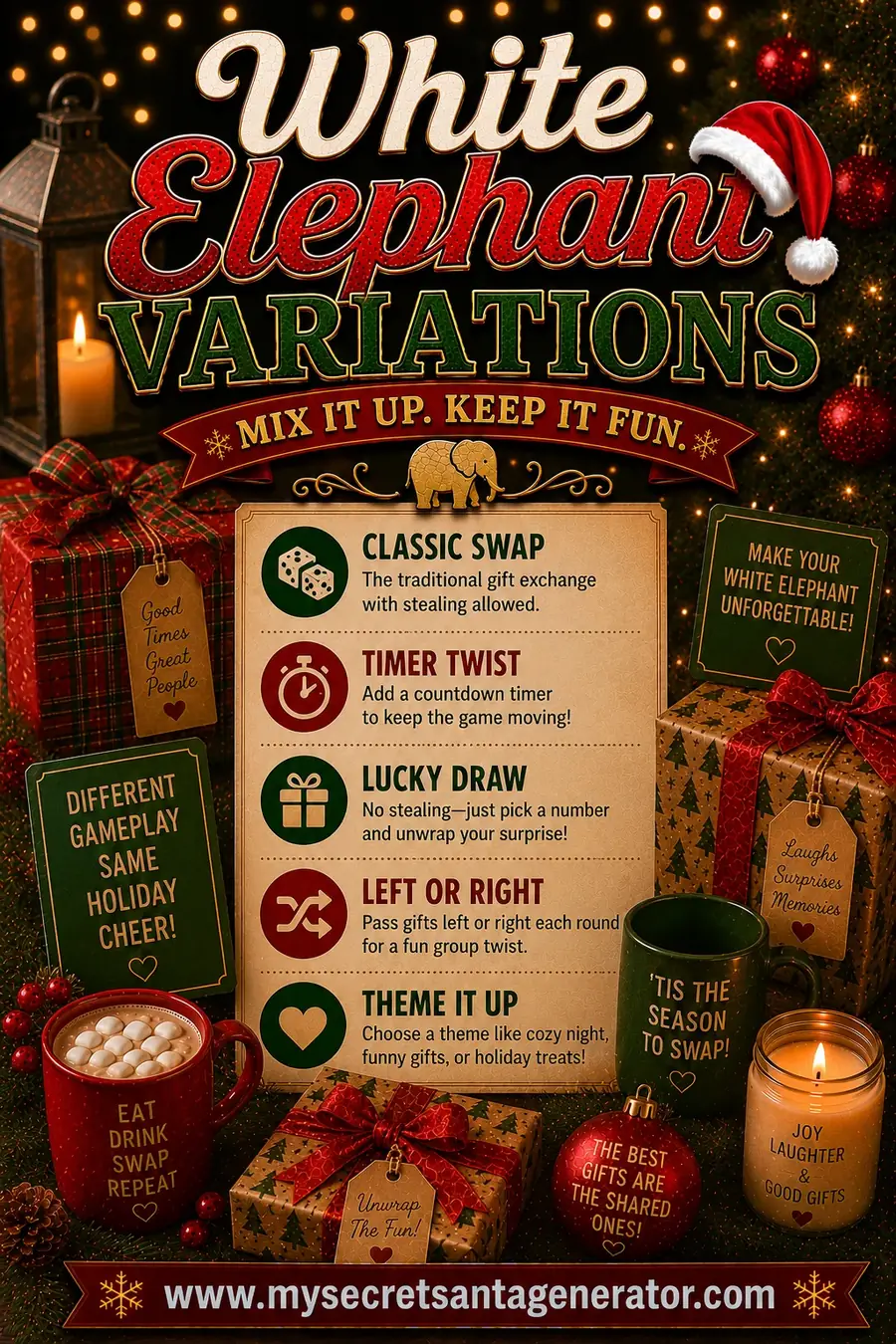
How it works: Everyone brings one wrapped gift. Players take numbered turns either opening a new gift or stealing an opened one. Steal limits (usually three per gift) prevent any one item from being taken indefinitely.
Best for: Mixed groups, office parties, any situation where people don't know each other well enough for personal gifting. Also great for groups that want the game to BE the entertainment.
Not ideal for: Small groups under 6 (limited steal opportunities), very young children (confusing mechanics), or groups where personal meaningful gifts are the goal.
Steal mechanic: The core of the game.
3. Pollyanna (or Kris Kringle)
How it works: Like Secret Santa but with a longer period of anonymous gift-giving leading up to a reveal. The gifter often leaves small gifts over several days or weeks before the final reveal. Common in schools and workplaces.
Best for: Groups that spend daily time together and want the gifting to extend across the lead-up to the holiday season. Creates sustained anticipation and a longer social experience.
Not ideal for: Groups that only gather once, remote teams, or any context where sustained daily contact isn't possible.
Steal mechanic: None.
Mid-Tier Formats
4. Gift Bingo
How it works: Gifts are placed in a grid. Players receive Bingo cards with gift descriptions or categories. Gifts are called out (opened) one by one. The first Bingo wins the right to claim any opened gift.
Best for: Large groups (20+) where the standard white elephant format would run too long. The Bingo mechanic caps the game time regardless of group size.
Not ideal for: Small groups (not enough gifts for a meaningful grid), groups who want consistent steal action throughout.
Steal mechanic: Modified — Bingo winners choose from opened gifts.
5. Left-Right Game
How it works: Everyone holds their wrapped gift. Someone reads a story aloud. Every time they say "left," everyone passes their gift left. Every time they say "right," everyone passes right. At the end of the story, you keep whatever gift you're holding.
Best for: Families with young children, low-key groups that don't want competitive dynamics, large gatherings where you need something everyone can participate in simultaneously.
Not ideal for: Groups that want strategy, groups where gift quality varies significantly (random assignment produces more awkward outcomes).
Steal mechanic: None — pure luck of the story.
6. Gift Auction
How it works: Each person receives a set number of fake bidding chips. Gifts are auctioned one by one to the highest bidder. Good gifts generate competitive bidding; the chips force budget decisions.
Best for: Groups that enjoy the economics and strategy of bidding, or groups where gift quality varies enough that an auction mechanism creates fair distribution.
Not ideal for: Casual groups who find bidding uncomfortable, groups with very young children, or short-time contexts.
Steal mechanic: None — allocation via bidding.
7. Naughty or Nice Trade
How it works: Players are randomly sorted into "naughty" and "nice." Nice players receive higher-value or more desirable gifts; naughty players receive gag gifts, coal-adjacent items, or joke gifts. The assignment is random, creating suspense before gifts are opened.
Best for: Groups with an established sense of humor and a tradition of playful competition. Works best when the "naughty" gifts are genuinely funny rather than just cheap.
Not ideal for: Groups where some participants might be genuinely disappointed by a bad gift, or any professional context.
Steal mechanic: Optional add-on.
Less Common Formats Worth Knowing
Pass the Parcel
How it works: One gift is wrapped in multiple layers. Players sit in a circle and pass it while music plays. When the music stops, the player holding the parcel removes one layer. Whoever removes the final layer keeps the gift.
Best for: Children's parties, groups of any age who want a simple, social, music-driven game. Very low-complexity.
Not ideal for: Exchanges where every participant needs to receive a gift.
Charity Exchange
How it works: Instead of buying for each other, participants buy gifts that are donated to a charity, shelter, or toy drive. The social element is replaced by a group giving activity.
Best for: Groups that want to redirect the gift budget toward something meaningful, groups with mixed income levels who want to eliminate pressure, or organizations that want to do something philanthropic for the season.
Not ideal for: Participants who genuinely enjoy giving and receiving personal gifts.
Mixing Formats in One Event
For longer parties or groups that want variety, running two formats back-to-back is increasingly common:
White elephant + Secret Santa reveal: Play white elephant as the entertainment game, then reveal Secret Santa assignments and give personal gifts afterward. The white elephant provides theatrical fun; the Secret Santa provides the meaningful personal moment.
White elephant + trivia: Run white elephant for 30–45 minutes, then pivot to Christmas trivia in teams. The game keeps energy high while white elephant creates the social opening.
Left-Right gift game + white elephant: The Left-Right game takes 10 minutes and works for any age. Follow it with a smaller white elephant for the adult group while kids play separately. Keeps everyone involved at their level.
The key to mixing formats: give each game enough time to land properly. A white elephant game that gets cut off after 20 minutes because trivia is starting doesn't feel satisfying. Sequence them with honest time estimates — "white elephant runs about 45 minutes, then we'll do trivia."
Frequently Asked Questions
What's the most popular gift exchange game?
White elephant (also called Yankee Swap or Dirty Santa) is the most widely played group gift exchange game. Secret Santa is the most popular one-on-one exchange format. Both are common at offices and family gatherings.
What's the best gift exchange game for an office?
White elephant or Yankee Swap. No personal knowledge required, scales to any team size, and the game itself provides entertainment regardless of how well coworkers know each other.
What's a gift exchange game that works for large groups?
Gift Bingo handles large groups efficiently. White elephant with a one-steal-per-gift limit also works well at scale — it dramatically reduces game time while keeping the stealing dynamic.
What's a good gift exchange game for kids?
The Left-Right Game — simultaneous, no competition, no confusion about rules. Pass the Parcel is the classic children's format if only one gift is available. Both work well for ages 4 and up.
What's a gift exchange game that's not white elephant?
Pollyanna (extended anonymous gifting over multiple days), Gift Bingo, the Left-Right Game, and Gift Auction are all distinct alternatives. A charity exchange is a completely different approach to the same spirit.
How do you choose between Secret Santa and white elephant?
Secret Santa: use when people know each other and personal meaningful gifts are the goal. White elephant: use when personal knowledge is limited, the group is large, or entertainment is the primary goal of the event.