Secret Santa Invitation Wording: How to Invite Your Group
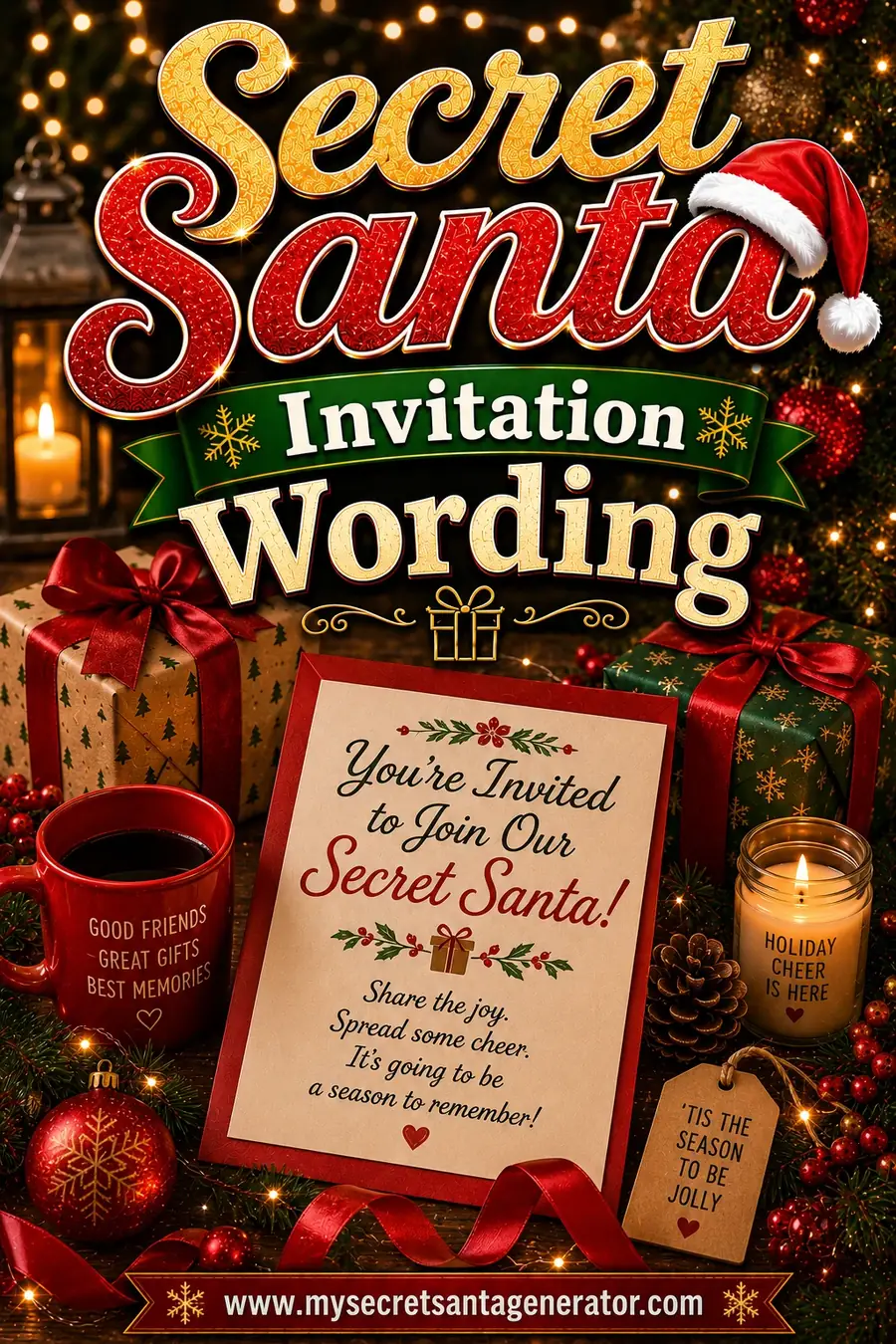
The invitation does two things: gets people to agree to participate and gives them the information they need to participate well. Most invitations do one but not both. They get the signup, then leave the group confused about the budget or the date.
A good Secret Santa invitation covers everything in one clear message so you don't spend December answering the same four questions over and over.
What Every Secret Santa Invitation Must Include
Before looking at templates, these are the non-negotiable elements:
1. What this is. Not everyone knows "Secret Santa" vs. "white elephant" vs. "Pollyanna." Name it and describe it in one sentence if your group has mixed familiarity.
2. The budget. The most common question after the invite. Say it clearly. Include whether it's a hard limit or a soft guideline.
3. The date and location. When gifts are exchanged, and where the party or exchange happens.
4. The sign-up deadline. When they need to RSVP by. Important for organizing the draw.
5. How assignments will work. Will you email them? Text them? Hand deliver? How soon before the exchange?
6. Any restrictions or exclusions. Some groups do "no gifts for your direct manager" or "no gift cards only" or other rules. State them upfront.
Optional but useful: a questionnaire link or wishlist instructions, so gifters have direction.
Sample Invitation Templates
For a Friend Group (Casual Tone)
Subject line: Secret Santa this year — who's in?
"Hey everyone —
We're doing Secret Santa again this year. Here's what you need to know:
- Budget: $25 (soft limit — don't stress if you go a little over)
- Exchange: December 20th at [Location], starting around [time]
- Sign-up deadline: December 5th
Reply to this message (or text me directly) to say you're in by December 5th. I'll do the draw and email assignments the same week.
If you want to share a short wishlist or a few notes about your preferences, include them when you RSVP. Your gifter will thank you.
Let me know!"
For an Office Exchange (Professional Tone)
Subject line: Office Holiday Secret Santa — sign up by [date]
"Hi everyone,
We're organizing a Secret Santa for the team this year. Details below:
Exchange date: [Date], [Time], [Location/Meeting room]
Budget: $20–$25
Sign-up deadline: [Date]
To participate: reply to this email with your name and any gift preferences or restrictions. All responses will stay confidential.
After the deadline, I'll send individual assignment emails. Gifts should be wrapped and labeled "To: [recipient name]" — please don't include your name on the outside until the reveal.
Questions? Reply here or message me directly.
Thanks — happy to organize this for the team."
For a Family Exchange (Warm Tone)
Subject line: Family Secret Santa — who wants in this year?
"Hi everyone,
Planning to do our usual Secret Santa this year — let me know if you're joining us.
A few things:
- Gift limit: $30
- Exchange: Christmas Eve/Day dinner (same as always)
- RSVP by December 10th so I can do the draw with enough time
I'll send assignments by December 12th. If you want to share any hints about what you'd like, include them when you RSVP and I'll pass them along to your gifter.
Can't wait to see everyone. Let me know you're in by the 10th!"
For a Virtual or Long-Distance Group
Subject line: Virtual Secret Santa — who's joining this year?
"Hi everyone —
We're doing a virtual Secret Santa this year. Since we're spread out, here's how it works:
- Budget: $30 (including shipping)
- Gifts ship directly to recipients — please have addresses ready by December 5th
- Gifter names revealed on December 20th over video call (or by group message if we can't make schedules work)
- Sign-up deadline: December 3rd
Reply to join. When you do, include your shipping address and any gift notes. I'll keep all addresses private and share only with gifters.
Draw goes out December 6th, gifts should arrive by December 18th."
Common Invitation Wording Mistakes
Leaving out the budget. The most common omission. The budget question is the first one you'll receive after sending a budget-free invite. State it in the first message.
No deadline. Without a sign-up deadline, stragglers delay the draw, which delays gifters, which compresses shopping time. The deadline is the organizing mechanism.
Too vague about the format. "We're doing a gift exchange" doesn't tell people whether to bring one wrapped gift, whether to draw names, or whether there are stealing rules. Name the format and briefly describe it.
Assuming everyone knows the rules. Even annual participants occasionally forget how the exchange works. A single sentence explaining the format is never wrong.
No RSVP mechanism. "Let me know if you're interested" is weaker than "reply to this email" or "fill out this form." A specific action produces more responses than a general invitation.
Invitation Wording for Special Formats
Not every Secret Santa is the standard draw-and-gift format. When your exchange has a twist, the invitation needs to explain the twist clearly upfront:
For a themed exchange:
"This year's exchange has a theme: [theme name].
All gifts must be [brief description of theme].
Examples: [two or three specific examples].
Not this: [what doesn't count].
Budget: [amount]. Exchange: [date and location]."
For a white elephant or Yankee Swap format:
"This year we're doing a white elephant exchange instead of a traditional Secret Santa.
How it works: everyone brings one wrapped gift. We draw numbers and open in order — anyone who opens a gift can steal an already-opened gift instead of opening a new one. Three steals per gift maximum, and the same gift can only be stolen twice.
Bring something that anyone in the group would genuinely want.
Budget: $[amount]. Exchange: [date]."
For an anonymous extended gifting format:
"This year we're doing a 12-days-of-December Secret Santa.
You'll receive small gifts anonymously from December 12–23, and the gifter reveals themselves on the 24th.
Commitment: approximately 12 small items totaling $[amount] over the period.
This requires more planning than a single-gift exchange — please only sign up if you can commit to the format."
Including the format explanation in the invitation prevents the confusion and rule disputes that arise when people show up expecting one format and encounter another.
What to Include in the Follow-Up After Sign-Ups Close
Once you have your list, the follow-up message should include:
- The person they drew (or a notification that it was sent separately)
- The recipient's wishlist or questionnaire answers (if collected)
- A reminder of the budget and exchange date
- Any last-minute logistics
This message does the most gifting work — it's the one gifters actually act on.
Frequently Asked Questions
What should a Secret Santa invitation include?
The six essentials: what it is, the budget, the date and location, the sign-up deadline, how assignments work, and any restrictions. Everything else is optional but useful — a wishlist request or questionnaire link significantly improves gift quality.
What's the right tone for a Secret Santa invitation?
Match the group. Office exchanges warrant a professional tone with a clear structure. Friend groups can be casual and short. Family invitations work well when they acknowledge the tradition, not just the logistics. The tone sets expectations for the whole exchange.
How far in advance should you send the invitation?
At least four weeks before the exchange — ideally five or six. This gives time for sign-ups, the draw, questionnaire responses, shopping, and shipping. A two-week lead is the minimum for anything but a simple in-person exchange.
Should Secret Santa invitations be sent by email or group chat?
Whichever your group actually reads. Email produces more organized responses (easy to track replies). Group chat is faster but easier to miss. For office exchanges, email is usually more appropriate. For friend groups, group chat may have higher engagement.
What do you do if people don't respond to the invitation?
Send one follow-up reminder a few days before the deadline with the specific date highlighted. If people still don't respond, proceed without them — don't let stragglers hold up the draw for everyone who committed.
Is it okay to include a questionnaire link in the invitation?
Yes — highly recommended. Including a questionnaire link (or asking for wishlist notes in the RSVP) produces dramatically better gifts. Frame it as optional to reduce friction: "Include any gift preferences with your RSVP — completely optional but your gifter will thank you."