Secret Santa Planning Timeline: When to Do What
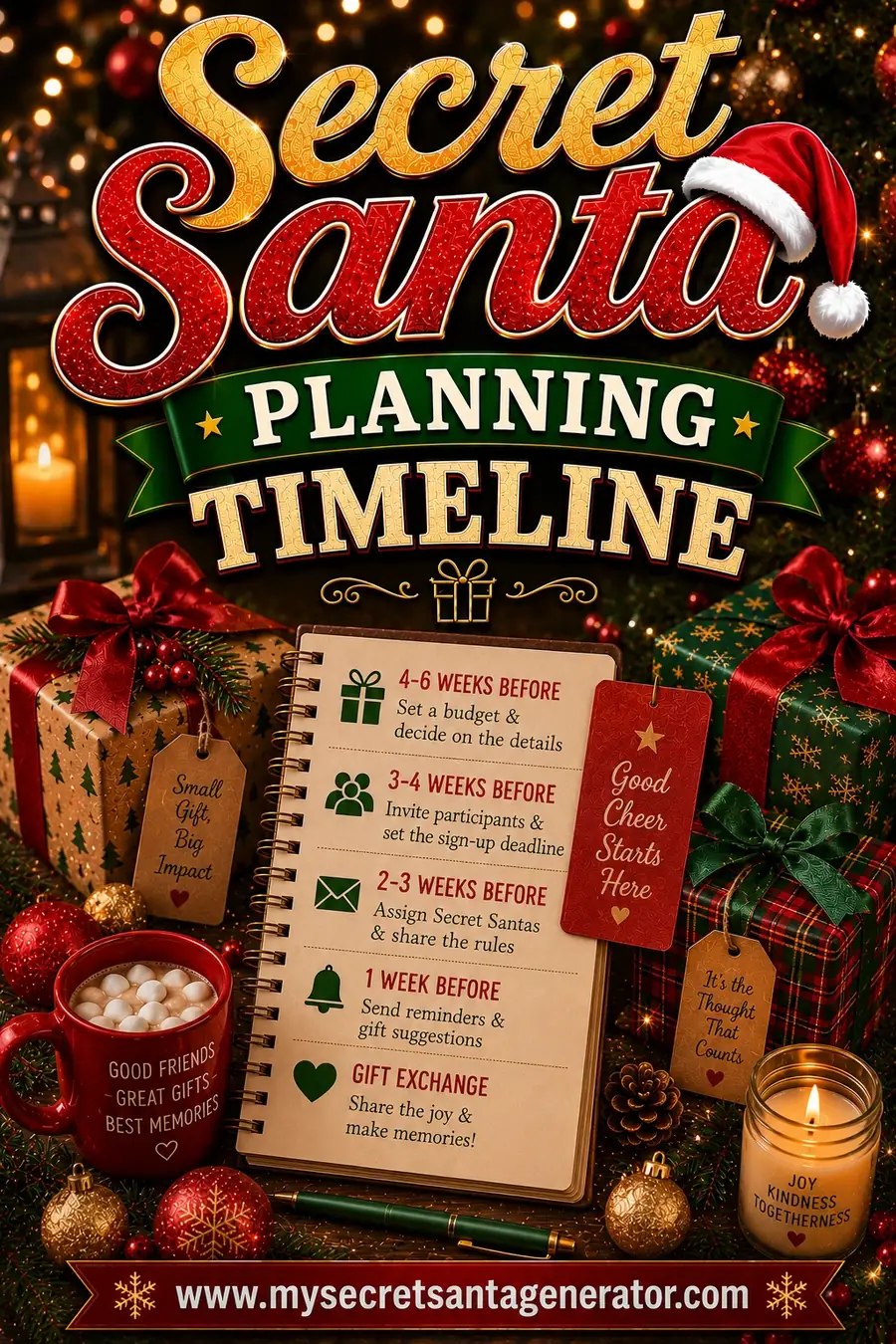
The two most common Secret Santa problems are: starting too late, and not giving people enough notice. Both are entirely avoidable. The exchange doesn't take much effort — it just needs that effort spread out at the right times rather than crammed into the week before Christmas.
Here's the timeline that actually works, built backward from Christmas Day.
Why Starting in October Isn't Too Early
Most people's instinct is to start thinking about Secret Santa in early December. By then, you're already behind:
- Online shopping shipping windows are closing
- People's schedules are filling up with other holiday events
- Anyone who needs to plan their budget in advance doesn't have enough time
- The draw was supposed to happen six weeks ago
October feels early. It isn't. Starting in October means your draw happens in late October or early November, people have four to six weeks to shop, and nobody is panicking about shipping deadlines. Start in December and you're stressing everyone out for no reason.
The Full Timeline: October Through December
Mid-October: Get Your Group Together
This is the organizing phase — no draw, no budget, just figuring out whether you're doing this and who's in.
What to do:
- Propose the exchange to your group (group chat, email, or in-person)
- Set a commitment deadline: "Reply by October 25th if you're in"
- Collect email addresses from anyone you don't already have
Don't run the draw yet. You need a confirmed list first. Anyone who hasn't replied by your deadline isn't in.
What NOT to do: Don't include "maybes." A maybe who bails after the draw leaves someone without a gift.
Late October: Set the Rules and Run the Draw
Once you have your confirmed participant list, do everything else at once:
What to do:
- Confirm the budget with the group (suggest a number, get agreement)
- Collect and finalize exclusions
- Run the draw — online generator recommended
- Send assignments with the budget, deadline, and any wishlist format included
This is the most active week of the whole process. Everything else is just follow-up.
Early November: Send the Questionnaire (If Using One)
If your exchange involves wishlists or questionnaires — and it should — now is the time.
What to do:
- Send your wishlist/questionnaire form to all participants (Google Form, simple email, whatever works)
- Set a response deadline: "Please fill this in by November 10th"
- Once responses are in, send each person their giftee's answers alongside a reminder of who they have
This is the step most organizers skip, and it's the one that most reliably improves gift quality. Even a two-question form makes a real difference.
Mid-November: Shopping Window Opens
People have assignments and giftee information. Now they shop.
What to do (as organizer):
- Send a gentle reminder to anyone who hasn't returned their questionnaire
- Nothing else — this period is for participants, not the organizer
Shopping tip for participants: Don't wait until December. November has better availability, less shipping pressure, and more time for a backup option if your first idea doesn't pan out.
Late November / Early December: The Shopping Deadline
For most exchanges, early December is the gift delivery deadline. The exact date depends on your reveal format:
In-person exchange at a holiday party: Gifts need to arrive at the venue (or be brought by the giver) by the party date. Set the gift-ready deadline a day or two before the event.
Virtual exchange (gifts shipped to recipients): With domestic shipping, gifts should be in the mail by December 1st–5th to arrive before Christmas. International gifts need to go even earlier — late November for some destinations.
Office exchange: Align with your office holiday party date. Gifts brought to the party, or delivered to the office before the designated exchange day.
Early-to-Mid December: Pre-Exchange Reminders
The organizer's job in December is mostly reminders and contingency planning.
What to do:
- Send a deadline reminder one week before the gift delivery date
- Check that nobody has dropped out or gone silent
- Prepare a backup gift (a neutral item in case of last-minute emergencies)
- Confirm reveal logistics — time, place, format
Send one reminder, not five. Adults who committed to an exchange know they have a gift to buy. One reminder is helpful; multiple reminders every three days is annoying and makes the organizer look anxious.
Exchange Day: Let It Be Fun
On the actual day of the exchange, the organizer's job is essentially done. Trust the process.
What to do:
- Have the backup gift available just in case
- Facilitate the reveal (manage the opening order, prompt the giver reveal)
- Keep the energy warm and celebratory
What not to do: Try to manage the pace too tightly, or become anxious about whether everything is going perfectly. It doesn't need to be perfect. It needs to be fun.
Condensed Timeline If You're Starting Late
Starting in late November instead of October? The compressed version:
- Week 1 (late November): Confirm group, set budget and rules, run draw in the same week
- Week 2: Questionnaires sent and returned (give people 3 days, not a week)
- Week 3: Shopping deadline — everything must be ordered or in hand
- Week 4 (mid-December): Gifts delivered/arrived, reveal happens before Christmas
This is tight but doable. The thing you sacrifice is stress-free shopping — people are buying gifts against the December shipping rush. It works; it's just more pressure than the October-start version.
If You're Starting in December
You're not actually that late for an in-person exchange. For a December 20th party, starting December 1st still gives people nearly three weeks to shop. Online orders placed by December 10th will typically arrive in time for standard domestic shipping.
What you can't recover from: starting in the third week of December. At that point, most online shipping deadlines have passed and physical shopping is chaotic. If this is where you are, consider running the exchange after Christmas (perfectly fine) or shifting to digital gifts (gift cards, subscriptions, experiences) that deliver instantly.
Frequently Asked Questions
Is October really early enough to start Secret Santa planning?
It's actually the right time. Late October to early November is the sweet spot — it gives participants six to eight weeks to shop before Christmas, which is enough time for thoughtful gift selection, online ordering, and shipping without stress.
What's the very latest you can start a Secret Santa and still make it work?
For an in-person exchange on December 20th–23rd, you can start as late as December 1st and still be okay — but people will be shopping in the height of the Christmas rush. For virtual or shipping-dependent exchanges, December 1st is the absolute latest start.
Should you send reminders during the shopping period?
One reminder, one week before the deadline. That's it. People who committed to the exchange are adults who know they need to buy a gift. Constant reminders erode goodwill.
What if your group has a holiday party date that's already set for early December?
Work backward from that date. If the party is December 8th, the draw needs to happen in late October so people have at least five weeks to shop. Earlier is always better.
How do you handle a Secret Santa for a group that doesn't have a set gathering date?
Set the deadline date yourself, then announce the reveal format — virtual call, individual deliveries, or a casual meet-up on a date you propose. Don't wait for the group to spontaneously organize a gathering. You're the organizer; set the date.
What's a good backup plan if gifts haven't arrived by the exchange date?
Keep a neutral backup gift (a nice candle, a gift card, a quality snack set) that the organizer can hand to anyone whose gift is delayed. The receiver gets something to open on exchange day, and the delayed gift arrives later. Works cleanly without drama.