Secret Santa Riddles: Hint at Your Gift With a Puzzle
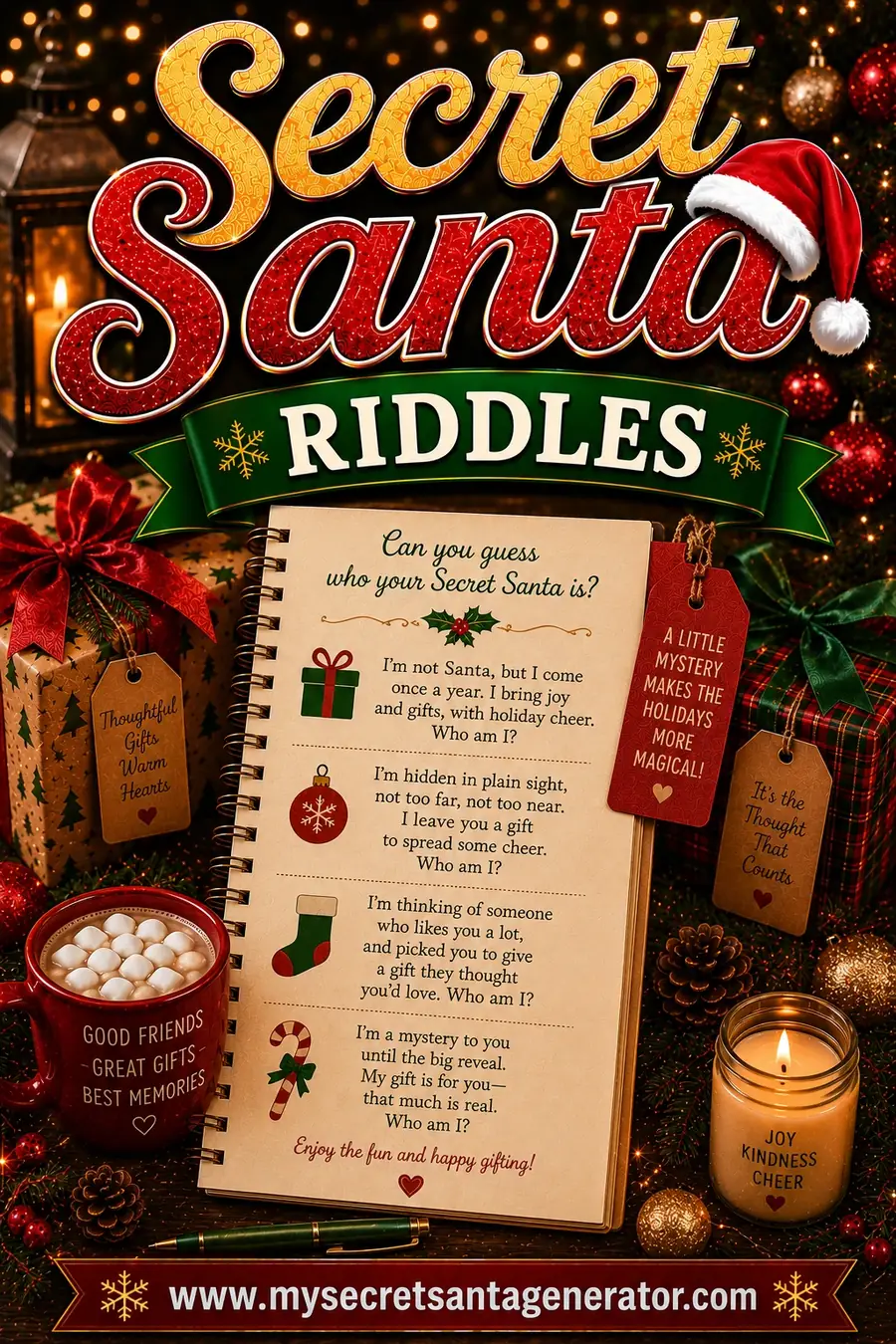
A Secret Santa riddle is the more satisfying cousin of the clue. Where a clue hints, a riddle requires the recipient to actually think — and the moment they figure it out (or open the gift and realize what it meant) is a better moment than a simple reveal.
The riddle works best tucked into the gift card, read before opening. Give the group a minute to guess before the unwrapping. That pause, the guessing, the "wait, is it..." — that's the experience.
Riddles for Common Gift Categories
For a Coffee-Related Gift
"I start your morning without saying a word.
I'm best when I'm hot. I'm worst when ignored.
I'm not an alarm clock, though both of us wake you —
The difference is I'll never make you want to break me."
(Answer: coffee or a coffee gift)
"I'm beans before I'm liquid, but liquid's how you know me.
I come in blends and single-origins, and the snobs among you'll show me.
I'm best in a quiet room before the rest of your day."
(Answer: specialty coffee)
For a Book
"I hold a world you haven't seen, and charge nothing for the entry.
I fit in a bag, I sit on a shelf, and I'm endlessly reusable.
I ask only one thing: that you actually start."
(Answer: a book)
"I'm heavier than I look when I'm good.
I never run out of battery. I've been around for centuries.
People who love me defend me passionately.
People who don't are usually people who haven't tried me yet."
(Answer: a physical book — good for a recipient who is new to reading or a skeptic)
For a Candle
"I'm not a fire, but I borrow fire's warmth.
I'm not a lamp, but I light the room differently.
I last longer when you care for me, and I smell like something specific that I'll make you think of every time."
(Answer: a candle)
For a Food Gift
"I can't be worn, I won't gather dust,
I ask no shelf space, I make no fuss.
I'm better when shared, though sharing's optional.
I disappear without leaving a mess."
(Answer: a food or edible gift)
"I started somewhere with a climate and a particular soil.
Someone with careful hands decided when I was ready.
I traveled to get here. I'll be gone soon.
That's the best possible outcome."
(Answer: specialty food — coffee, chocolate, tea, artisan condiment)
For a Cozy Gift (Blanket, Socks, Slippers)
"I'm for the hours nobody sees.
I'm at my best when you're off the clock.
I ask nothing of you except to let the day go."
(Answer: a cozy gift — blanket, slippers, warm socks)
For a Gift Card
"I'm all potential and no decisions yet.
I'm the right amount and the right store — the rest is yours.
Some consider me impersonal. Those people have never been given the wrong gift."
(Answer: a gift card — works as a gentle self-aware acknowledgment)
For a Practical Everyday Item
"I'm not exciting. I know that.
But you use my category every day and yours is past its best.
I'm the version of ordinary that surprises you by how much better it is."
(Answer: a practical upgrade — a quality pen, a better water bottle, a nice notebook)
For a Skincare or Self-Care Gift
"I'm for the version of you that actually has a routine.
I'm also for the version that keeps meaning to start one.
I require roughly three minutes and a bathroom."
(Answer: a skincare or self-care product)
For a Plant
"I photosynthesize. I don't speak.
I'm remarkably low-maintenance for something alive.
I'll be in your home for years if you remember one or two things about me.
I'm patient either way."
(Answer: a plant)
For a Board Game or Card Game
"I'm best with more people, though I can work with two.
I produce arguments, laughter, and occasionally a temporary grudge.
I have rules. They will be disputed."
(Answer: a card game or board game)
How to Write Your Own Riddle
If none of the examples above fit your gift exactly, write your own. The formula:
1. List what the gift IS NOT — common things it resembles but isn't. This creates the misleading-accurate territory where good riddles live.
2. List what it DOES — what experience it creates, what morning routine it belongs to, what hour of the day it's for.
3. List what it REQUIRES — maintenance, a routine, a particular person to appreciate it.
4. Pick the most evocative items from each list and arrange them into 3–4 lines.
Example for a tea gift:
- Is not: coffee, wine, or juice
- Does: warm you from the inside without urgency, asks you to wait for it
- Requires: a kettle, a few minutes, somewhere to sit
Result: "I'm slower than coffee and better for it. I ask you to wait, which is the whole point. I'm best in a place with a window and nothing urgent. I've been doing this since before the coffee people showed up."
Riddles That Work for Unusual or Hard-to-Describe Gifts
Some gifts resist categorization. The generic gift riddle is your best tool here — it works by describing the experience the gift produces rather than the category it belongs to.
For a gift card:
"I'm all potential and no specifics yet.
I represent a decision you get to make,
at a time and place of your choosing,
at the right amount.
Some people consider me impersonal.
Those people have clearly received the wrong gift before."
For something homemade or handmade:
"Someone made this with their hands.
The materials are secondary.
The hours are the main ingredient.
Handle it accordingly."
For a gift you found unexpectedly:
"I wasn't looking for you when I found this.
I found it and thought of you immediately.
That's either a good sign about the gift or a good sign about how well I know you.
Possibly both."
For a subscription or experience gift:
"This doesn't start yet. It starts later, when you're ready.
I've given you something to look forward to,
which is arguably a better gift than something to unwrap.
I stand by the logic."
These riddles emphasize the circumstances around the gift — how it was found, what makes it special, what it will produce — rather than describing what the object is. For unusual gifts, this approach works better than trying to create clever misdirection about a thing that's already unusual.
Frequently Asked Questions
What is a Secret Santa riddle?
A short puzzle — usually three to five lines — tucked in the gift card that hints at what's inside without naming it outright. The recipient reads it before opening and tries to guess.
How do you write a Secret Santa riddle?
Focus on what the gift DOES and when it's used rather than what it IS. Describe the experience it creates, the time of day it belongs to, or the feeling it produces. Avoid naming the category directly until the very last line (if at all).
Are Secret Santa riddles different from clues?
A clue is usually a sentence — a hint. A riddle has a puzzle structure: multiple lines that misdirect slightly before resolving. The riddle requires more thought; the clue is more direct. Both work; riddles are more elaborate.
When do you read the riddle?
Before opening the gift, ideally aloud to the group. Give everyone a moment to guess. The gap between the riddle and the reveal is the experience — don't skip it by opening immediately.
What if the riddle is too hard?
That's fine. The recipient opens the gift and then re-reads the riddle — the "oh, that's what that meant" moment is its own satisfying experience. You can give a small hint if the group is stumped.
Do Secret Santa riddles have to rhyme?
No. Rhyming riddles are charming when they flow naturally but forced rhymes undermine the whole thing. Prose riddles that don't rhyme are perfectly effective and often more elegant.