
White Elephant Rule Variations: Make the Game More Fun
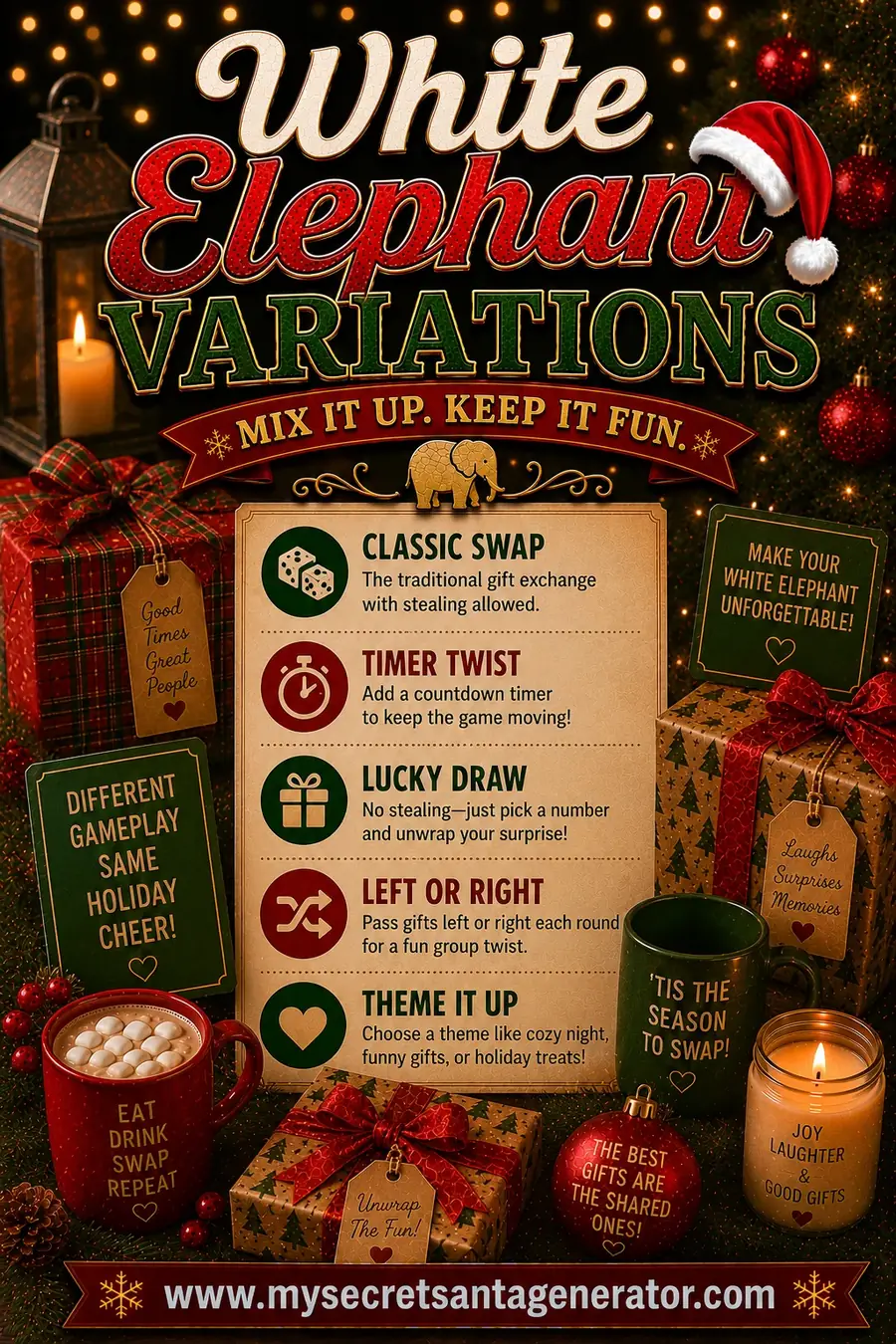
The standard white elephant rules are fine. A number draw, open-or-steal turns, a three-steal limit, done. But after the third or fourth year of running the same format, the same rules start to feel predictable.
These variations keep the game fresh — some add strategy, some add chaos, some speed it up, some make it genuinely theatrical. Pick the one that fits what your group is missing from the standard format.
Speed Variations
Double-Dip Freeze (One Steal Per Gift)
Once a gift is stolen once, it's frozen permanently. The person who received it keeps it for the rest of the game.
Effect: Dramatically faster. Game runs in roughly half the time of standard rules. Every gift settles after one steal.
Best for: Large groups (20+) where turns take a long time, or parties where the gift exchange is one event among many.
Trade-off: Less strategy, fewer dramatic steal chains, the competitive element is reduced significantly.
Timed Turns
Each player has 30 seconds (or 60 seconds for larger groups) to decide whether to open or steal. A visible timer runs. If they don't decide in time, they must take from the pile.
Effect: Eliminates the extended deliberation that can slow the game. Creates mild pressure and occasional comedy when someone panics and grabs randomly from the pile.
Best for: Large groups with long deliberators, or any group where the game regularly stalls on individual turns.
Trade-off: Reduces the strategic element for people who like to think carefully.
Open-All-First
All gifts are opened simultaneously. Then a steal phase begins with full information — each player gets one steal in number order.
Effect: Much faster total runtime. Every player sees every gift before the game begins. The steal phase is pure information-based strategy rather than gradual revelation.
Best for: Office parties with limited time, large groups that want to keep things moving.
Trade-off: Removes the excitement of the individual reveal — a lot of the drama of white elephant comes from the gradual opening and the uncertainty of what's in each gift.
Chaos Variations
Unlimited Steal Chains
Instead of one steal per turn, each steal can trigger another steal in the same turn. Player 5 steals from Player 3, which allows Player 3 to steal from Player 1, which triggers Player 1 to open from the pile.
Effect: Dramatically increases chaos, extends individual turns, and creates longer and more dramatic gift battles.
Best for: Competitive friend groups who enjoy the theatrical element of the game and have time to let chains run out naturally.
Trade-off: Can significantly extend the game. One popular item can create a chain that takes five minutes to resolve.
No Freeze Rule
The standard three-steal limit is removed. Gifts can be stolen an unlimited number of times.
Effect: Maximum chaos. The most desirable gifts circulate indefinitely. The game ends only when everyone runs out of steal motivation.
Best for: Extremely competitive groups who understand the implications and want the most chaotic version possible.
Trade-off: Can extend the game dramatically. Can create frustration for anyone who loses a highly contested gift repeatedly. Requires self-policing to know when to stop.
The Reverse Round
After all players have taken their original turn, the order reverses. Player N goes again, then N-1, down to Player 1. Each player gets one additional steal in this reverse round.
Effect: Every player gets two opportunities, which creates more movement and more satisfaction. The reverse round often reshuffles the most coveted items.
Best for: Groups that find standard rules slightly unsatisfying — people who feel their number position was too disadvantaged.
Trade-off: Roughly doubles the game time.
Strategy Variations
Disguised Wrapping Rule
All gifts must be wrapped to disguise their contents. Heavy gifts should be padded to feel light; oddly shaped items should be disguised in boxes. The rule prevents visual or tactile pre-selection.
Effect: Levels the playing field dramatically. The person who "feels" every gift before opening is no longer at an advantage. Choices are made on revealed information, not pre-opening intel.
Best for: Groups where some participants physically examine gifts before choosing.
Trade-off: Requires more preparation time for gifters. Some people find the mystery aspect frustrating rather than fun.
Peek Tokens
Each player gets one Peek Token at the start. They can use it at any time to look at the contents of any wrapped gift before deciding to take it (others can't see). Can only be used once.
Effect: Adds an information-advantage mechanic. Using the peek early provides strategic information but depletes your only token. Waiting longer means more options but less time.
Best for: Groups that enjoy games with resource management elements.
Trade-off: More complex rules to explain and track.
The Auction Round
After the standard white elephant game ends, an auction round begins. Players receive chips (equal amounts). Any unhappy player can put their gift up for auction. Other players bid for it with their chips. Highest bidder gets the gift; the original holder gets the chips (which can be used in subsequent auctions).
Effect: Creates a market mechanism for reallocation. Players who ended up with unwanted gifts can potentially trade up. Players who lost coveted items can try to buy them.
Best for: Groups where gift-quality variance is high — some very desirable items and some clearly unwanted ones. The auction smooths this out.
Trade-off: Significantly extends the game. Requires chip management setup.
Theme Variations
Category-Only White Elephant
All gifts must fit a predetermined category: food gifts only, cozy gifts only, books only, gifts under $15 only, tech accessories only.
Effect: Reduces gift-quality variance dramatically. When everyone brings from the same category, the game becomes more competitive because the gifts are more comparable.
Best for: Groups that want a more focused exchange, or groups where category theming creates a natural social hook.
Trade-off: Restricts creativity. Some gifters find open themes more fun.
Which Variation to Choose
If you're looking at this list and aren't sure which variation to run, here's the decision in simple terms:
Game is running too slow: Double-dip freeze (one steal) or timed turns. Both cut the runtime.
Game feels predictable: Reverse round or unlimited chains. Both add more movement and drama.
Someone always complains about their position number: Reverse round or auction finale. Both give disadvantaged positions more opportunities.
Group is competitive and strategic: Peek tokens or open-all-first format. Both add information-management elements.
Want to try something completely new: Category-only with an auction finale. A fresh format from start to finish.
Group is playing for the first time: Standard rules. Introduce variations once people know the baseline. Explaining a variation to first-time players before they understand the standard game creates confusion.
The rule changes that add the most drama are the unlimited chain variations. The rule changes that create the fairest outcomes are the reverse round and auction finale. The rule changes that speed things up most are the double-dip freeze and timed turns. Match the variation to what the game most needs.
Frequently Asked Questions
What are some fun white elephant variations?
Unlimited steal chains for maximum chaos, timed turns to keep the game moving, the reverse round for fairer outcomes, or category-only theming for a more focused game. Each solves a different problem with the standard format.
How do you speed up white elephant?
The double-dip freeze (one steal per gift, then frozen permanently) cuts game time roughly in half while keeping the steal mechanic. The open-all-first format is even faster — everyone opens simultaneously, then one steal round.
How do you make white elephant more competitive?
Unlimited steal chains, the reverse round, or removing the steal limit entirely. All three increase the number of times coveted gifts change hands.
What's the fairest white elephant format?
The auction finale variation gives every player a post-game opportunity to reallocate through bidding, which most closely produces outcomes where everyone gets something they want. The reverse round also helps balance position advantages.
Can you play white elephant without numbered turns?
Yes — some groups use a volunteer system (anyone can choose to go next), a random spinner, or a dice roll. Numbered turns are just the most common and fair mechanism for determining order.
What's the best white elephant variation for a large group?
Timed turns (30 seconds per decision) plus the double-dip freeze (one steal per gift). Combines speed with a basic competitive element. For groups over 30, the open-all-first format with one steal round is the fastest and most manageable.