
Yankee Swap Rules: How to Play and Run a Smooth Exchange
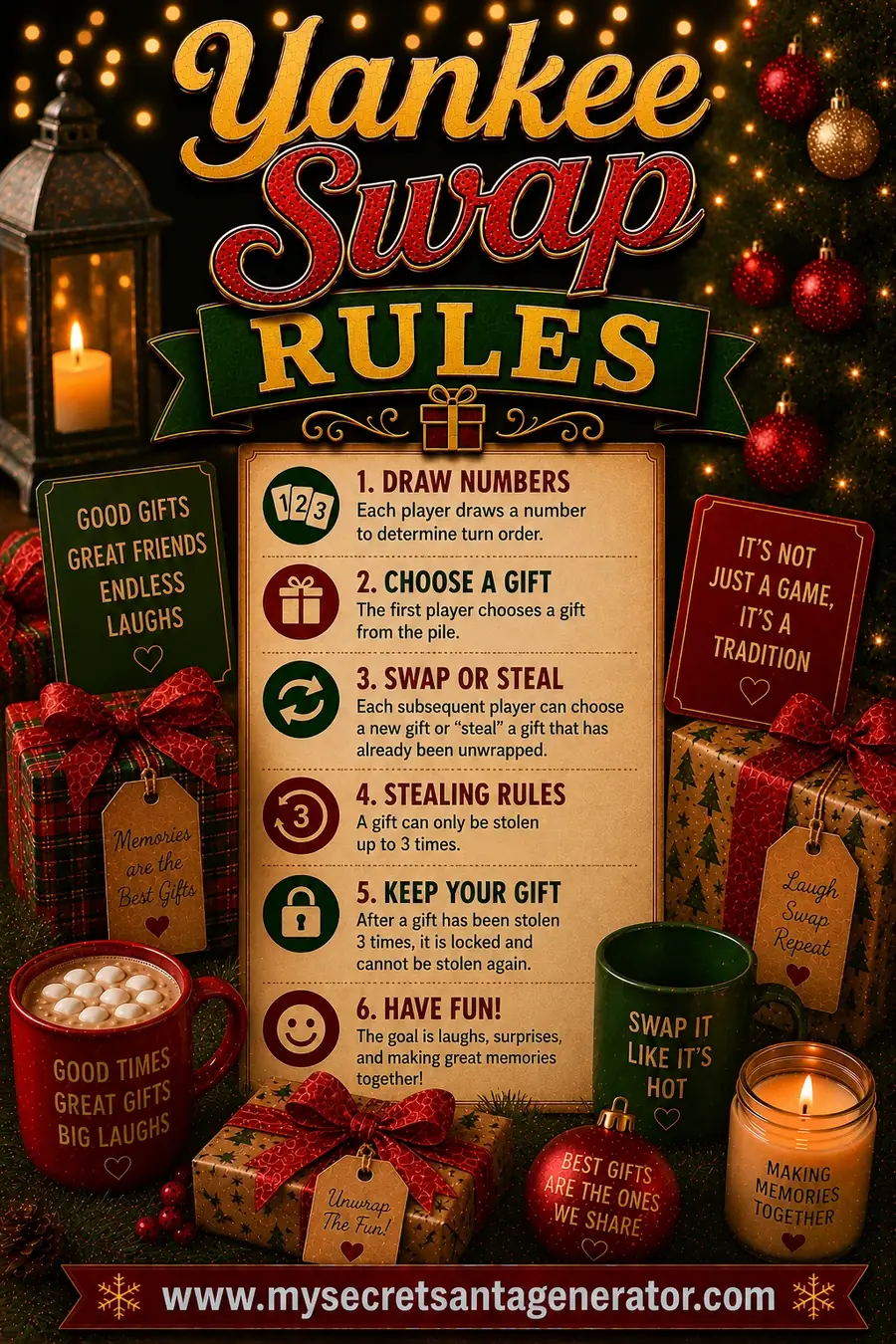
Yankee Swap is what people in the northeastern United States call the gift stealing game that the rest of the country calls white elephant (and the South calls Dirty Santa). The rules are essentially the same across all three names — numbered turns, open-or-steal choice, steal limits — but regional variations in the rules do exist, which is why it's worth laying out the standard format clearly.
The Standard Yankee Swap Rules
Before the Game
- Each participant brings one wrapped gift at the agreed-upon budget
- All gifts are placed in a central pile or under the tree
- Nobody knows who brought what (no name tags on the outside)
Number Draw
Participants draw numbers to establish turn order. Number 1 goes first, with the highest number going last.
Turn Structure
Person 1: Picks any wrapped gift from the pile and opens it. Everyone sees what it is.
Person 2 and beyond: On each turn, the current player can either:
- Pick a new, still-wrapped gift from the pile, OR
- Steal any already-opened gift from another player
If your gift is stolen: You must immediately open a new gift from the pile. You cannot steal back the gift that was just taken from you on the same turn (it is frozen for one round).
The Steal Limit
The most widely used rule: any single gift can be stolen a maximum of three times total. After three steals, it's frozen permanently with whoever currently has it. This prevents any one item from dominating the game.
The Final Round
After the last player has taken their turn, Player 1 gets one final option — they can steal any gift in the room (including frozen ones, depending on your house rules). If they steal, the person whose gift was taken must open the last remaining wrapped gift. Play continues until all gifts are open.
End of Game
Once all wrapped gifts are opened and all steals are resolved, the game ends. Everyone keeps what they're holding.
Yankee Swap vs White Elephant vs Dirty Santa
All three names describe the same fundamental game with slightly different regional conventions:
Yankee Swap (Northeast US): Typically slightly more formal rules. Sometimes uses a "swap" phase at the end where players can swap gifts with each other, rather than continuing individual turns. The final-round swap distinguishes it from some white elephant formats.
White Elephant: The most widely used name nationally. The rules are essentially identical to Yankee Swap. Sometimes involves deliberately "white elephant" (unwanted, re-gifted, or gag) items specifically — the name implies low-quality or humorous gifts.
Dirty Santa (Southeast US): The same stealing mechanics, with "dirty" referring to the competitive stealing element rather than anything else. Southern groups often use slightly more aggressive steal limits and encourage the competitive theater more explicitly.
For all practical purposes: same game, different regional names, slightly different cultural flavor. If you're running one and your group uses another name, run the same rules.
Popular Rule Variations
The Double-Dip Freeze: A gift can only be stolen once (not three times). This dramatically speeds up the game — most gifts settle with their first steal recipient. Good for large groups where a longer game creates disengagement.
The Open-All-First Format: All gifts are opened simultaneously before any stealing begins. The steal phase then runs separately with full information. This removes the suspense of opening but gives everyone equal information before choosing targets.
Timed Steals: Each player has 30 seconds to decide whether to steal or open. This eliminates the extended deliberation that can slow the game down with larger groups.
Anonymous Gifter Reveal: After the game, the person who brought each gift reveals themselves. This adds a social element to the aftermath and lets people thank their specific gifter.
Themed Exchange: All gifts must fit a category — foodie items only, books only, cozy gifts, under-$15 only. This reduces the variance in gift quality and creates a more cohesive game.
Tips for Running a Smooth Yankee Swap
Announce the rules before starting. Not after the first steal causes a dispute. Put the key rules on a card where everyone can see them: steal limit per gift, whether chains are allowed, what happens when the pile runs out.
Designate a timekeeper. For groups prone to deliberation, a 30-second rule for steal decisions keeps things moving.
Track steals visually. For the items most likely to be contested, a simple "I, II, III" mark keeps everyone honest about whether a gift has hit the steal limit.
Have a tiebreaker rule ready. "What if two people want to steal the same gift on the same turn?" Decide before the game: most groups use "whoever drew the earlier number" as the tiebreaker.
Don't let the pile run dry without a plan. If steals continue and the pile empties, the game can stall. The standard resolution: once the pile is empty, any player who loses a gift to a steal is eliminated (they hold nothing). Play continues until steals stop naturally.
Setting Up Yankee Swap Digitally
For groups that can't meet in person, or for groups that want to handle the number draw and gift assignments before the event, digital tools help:
Name drawing and number assignment: A simple online random number generator works fine for turn order. Use any free "random number generator 1 to N" tool and assign numbers at the start of a video call.
Virtual Yankee Swap: The game can be played over video with shipped gifts. Each participant ships their wrapped gift to a central location (or to whoever draws their number in advance). During the video call, run the standard turns. Gifts are revealed over video; physical delivery was handled ahead of time.
Hybrid format: In-person group but some remote participants. Remote participants can still play — they bring a gift that's delivered to the central location, and they participate in turns via video. Their gift gets stolen like any other; when they win a steal, someone holds up the gift and ships it to them afterward.
The key for virtual Yankee Swap: establish whether stolen gifts are physically present at one location or shipped after the game resolves. Decide this before the event to avoid post-game logistics confusion.
Frequently Asked Questions
What are the rules for Yankee Swap?
Each person brings one wrapped gift. Players take numbered turns either opening a new gift or stealing an opened one. Stolen gifts are frozen for one round. Maximum three steals per gift. Player 1 gets a final steal option after everyone else's turn. Game ends when all gifts are claimed.
Is Yankee Swap the same as white elephant?
Essentially yes — the same stealing gift exchange game with a regional name variation. Yankee Swap is primarily used in the Northeast US. "White elephant" is more common nationally. The rules are functionally identical; local groups may have slight variations in steal limits or the final swap mechanic.
How many times can a gift be stolen in Yankee Swap?
Standard rule: three times. Some groups use two (faster, less contentious) or unlimited (maximum chaos, not recommended for most groups). Agree on the limit before the game starts.
What happens when someone steals from you in Yankee Swap?
You must immediately pick a new unwrapped gift from the pile. If the pile is empty, various house rules apply — most common is that you can steal from anyone who hasn't already had their gift stolen this round.
Who has the best position in Yankee Swap?
The last player in turn order, by significant margin. They have full information about every opened gift and can steal anything. Player 1's compensation is the end-game final steal, which makes their position second-best.
Can you use Yankee Swap for an office party?
Yes — it's one of the most popular office party formats because it requires no personal knowledge of recipients and scales well to any team size. Keep the steal limit clear and communicate the rules before starting to minimize mid-game disputes.