Secret Santa Form: Collecting Names, Wish Lists and Rules
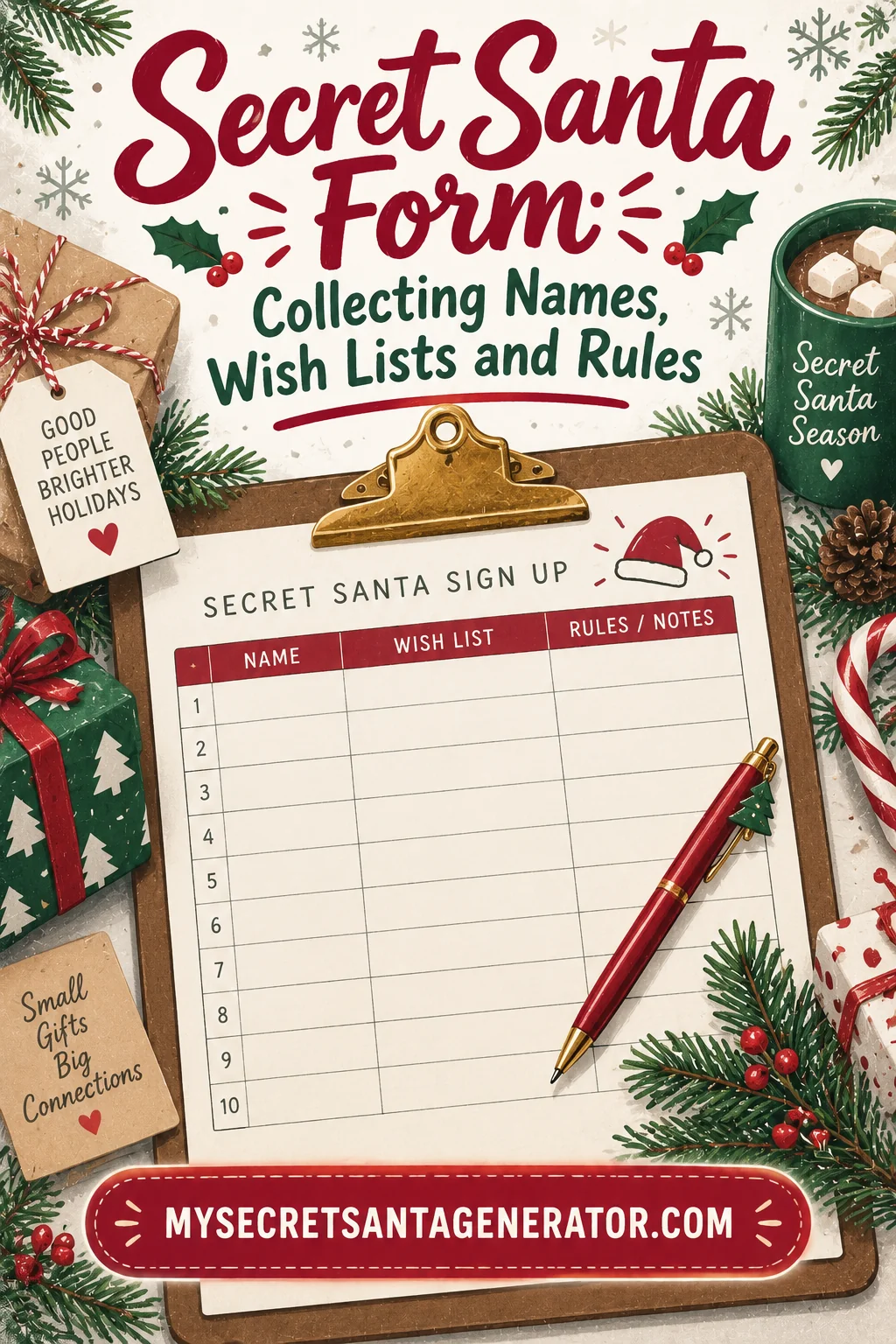
A secret santa form is the sign-up sheet that collects everything the organizer needs before names are drawn: each participant's name, a contact address, a short wish list, anything they cannot receive, and any person they should not be paired with. Get those five fields answered by everyone and the rest of the exchange runs itself. Skip the form and you spend two weeks chasing people in hallways and group chats.
The form is the unglamorous half of the whole tradition, and it is the half that decides whether people end up with gifts they want. This covers exactly what belongs on the form, how to write the wish list section so people actually fill it in, what rules to state up front, and how to turn a stack of responses into a clean draw.
What Goes on the Form
Seven fields, in this order. Every one of them exists because leaving it off causes a specific problem.
- Full name. Not a nickname. In a company of any size, two people named Chris will break the draw.
- Contact address. Email or phone. This is how the assignment reaches them privately, and it is the field most often filled in wrong.
- Department, team, or table. Optional in a family, essential at work. It lets you avoid pairing two people who sit six feet apart, if that is what your group wants.
- Wish list: three to five specific things. Detail below, because this is where most forms fail.
- Do not give me. Allergies, scent sensitivities, dietary restrictions, and anything the person genuinely does not want. This field prevents the one bad outcome that people remember for years.
- Exclusions. Anyone they should not be assigned. Couples, people who exchange separately, someone who had them last year.
- Confirmation that they are in. A checkbox, not an assumption. Nothing derails an exchange like a name in the draw belonging to someone who never agreed to participate.
Two optional fields worth adding for workplace exchanges: whether the person will be present on the exchange date, and whether they are comfortable receiving something in front of a group. Both save awkwardness later.
Writing the Wish List Section So People Answer It
The wish list is the part everyone leaves blank or fills with "anything is fine," which is the least helpful answer possible. It puts the entire burden on the giver and produces the generic gifts that make people cynical about the whole tradition.
Fix it with the question itself. Do not ask "what do you want." Ask three narrower questions:
- Something you use up and always need more of. Coffee, tea, hot sauce, good socks, notebooks, seeds.
- Something you have been meaning to try. A hobby they are curious about, a book on a subject they like, a puzzle.
- A category and a detail. "Tea, but only herbal." "Books, and I have read everything by these three authors." "Anything for the grill."
Add a required note about sizes if clothing is in play, and a line asking for a color they would never wear. Both are far more useful than the wish list itself, because they turn a vague category into a safe choice.
Plenty of organizers go looking for a "secret santa questionair" with the spelling exactly like that, and what they are really after is this section: a short questionnaire that gets a person to reveal their taste without them having to name a specific product. Five good questions beat a blank box every time.
The Rules Section
Half of a good form is not a question at all. It is the rules, printed at the top, so nobody has to ask. State these clearly:
- The spending limit the group has agreed on. One number, agreed in advance, applied to everyone. It is the fairness mechanism the whole tradition depends on, and it should be settled before the form goes out rather than debated in the replies.
- The exchange date, time, and place. Including whether remote participants mail their gift and by when.
- The response deadline. Always earlier than you think you need, because a third of the group will answer on the last day.
- Whether anonymity holds after the exchange. Some groups reveal, some never do. Decide, then say so.
- Homemade, secondhand, and consumable gifts: allowed or not. This causes more friction than anything else on the list.
- What happens if someone drops out. Say that the organizer will redraw and that the affected pair will be told.
- Who to contact with a problem. One name, one address.
Those are your secret santa rules in the narrow sense. Keeping them to a short block at the head of the form is better than a separate email, because the rules and the sign-up should never live in two places.
How to Play Secret Santa, in Four Steps
For anyone running it for the first time, here is how to play secret santa from start to finish:
- Collect participants using the form. Close it on the deadline.
- Draw names, so that every person gives to exactly one person and receives from exactly one person, with nobody drawing themselves and no exclusion violated.
- Tell each person privately who they are giving to, along with that person's wish list and restrictions.
- Exchange gifts on the agreed date, anonymously, with the giver either revealed at the end or not, depending on your rule.
That is the whole game. The only genuinely difficult part is step two once exclusions are involved, which is why hat-drawing falls apart in groups with couples in them.
Paper Form or Electronic Form
Both work. The choice depends on the group.
| Paper form | Electronic form | |
|---|---|---|
| Best for | Small teams in one room, classrooms, family gatherings | Remote teams, large groups, anyone spread across sites |
| Response rate | High if you hand it over in person | Depends entirely on reminders |
| Wish list quality | Short, because people fill them out standing up | Better, because people answer at their desk |
| Privacy | Weak — the sheet sits on a desk | Strong if responses go to one organizer |
| Effort to compile | You retype everything | Already in a list |
People searching for a secret santa electronic option are usually solving one specific problem: they have participants in more than one place and cannot pass a sheet around. That is exactly the case where a digital form pays for itself, because the responses arrive already collated and the assignments can be sent out privately without the organizer ever seeing a gift in progress.
The other reason to go digital: the organizer can be a participant. If you draw names out of a hat, the person holding the hat knows too much. An automated draw lets the organizer be surprised like everyone else.
Using a Secret Santa Website
A dedicated secret santa website does three things a spreadsheet cannot: it randomizes the draw with exclusions applied, it emails each person only their own assignment, and it stores the wish lists where the right person can see them. Search interest in phrases like elfster secret santa shows how many organizers go looking for a hosted service instead of building the process themselves, and the reason is almost always the second item on that list — sending assignments privately without a human reading them.
If you want to do the draw itself without any account, a Secret Santa generator will take your list of names and produce the pairings. Collect the form responses however you like, then feed the names in.
Turning Responses Into a Secret Santa List
Once the form closes, build one clean secret santa list before you draw anything. One row per person, with name, contact, wish list, restrictions, and exclusions in fixed columns. Then do three checks:
Check the count. Every participant must appear exactly once. Duplicates from someone submitting the form twice are the most common error, and a duplicate breaks the draw silently.
Check the exclusions for impossibility. A group of four where three people all exclude each other has no valid arrangement. Small groups with many exclusions are where draws fail, and the failure looks like an infinite loop rather than an error message.
Check the contact addresses. Send a one-line confirmation to everyone before the draw. A typo in an address means one person never learns who they have, and you will not find out until the exchange.
Only then draw. And once names are drawn, do not redraw casually — every redraw is another chance for someone to see something they should not.
Chasing the People Who Have Not Responded
Assume a quarter of your group will not fill in the form by the deadline. Plan for it rather than being annoyed by it.
- Send the form with the deadline in the subject line, not buried in the body.
- Post one reminder two days before the close, listing how many people are still outstanding but naming nobody.
- Ask a person in the room to chase the last few in person. This works better than any number of messages.
- Have a fallback for empty wish lists. If someone submits with no list, ask their closest colleague or sibling for two ideas and attach those instead of leaving the giver with nothing.
Do not extend the deadline more than once. Extending twice teaches everyone that the deadline is not real, and next year is worse.
A Form You Can Copy
Use this as the body of your own form, adjusting the fields you do not need:
Our exchange takes place on [date] at [time] in [place]. The agreed spending limit is [limit]. Homemade and consumable gifts are [allowed / not allowed]. Please respond by [deadline].
Your full name. Best email or phone for your assignment. Team or table. Three to five things you would genuinely like, with enough detail that a stranger could pick one. Anything you cannot receive, including allergies and scent sensitivities. Sizes, if you are listing clothing. A color you would never wear. Anyone you should not be paired with, and why. Will you be there on the day? Tick to confirm you are taking part.
That is a complete sign-up. Forms for secret santa exchanges get abandoned when they run past about ten questions, so resist the temptation to add favorites-of-everything sections. The three or four questions that reveal taste are worth more than fifteen that read like a personality quiz.
Common Mistakes
No deadline. The form stays open, the draw slips, and gifts get bought in a panic.
Wish lists nobody can act on. "Surprise me" is not an answer. Push back once, politely, and offer to help.
Ignoring exclusions. If two people asked not to be paired and the draw pairs them anyway, they will assume it was deliberate.
The organizer drawing themselves in. If you run the hat, you know things. Use an automated draw or have someone outside the group do it.
Letting the limit float. Without a stated limit, one person overspends, everyone else feels bad, and the exchange gets a reputation. Agree it before the form goes out.
Collecting addresses and then losing them. Keep the responses in one place, and delete them after the exchange if the group is a workplace.
Frequently Asked Questions
What should a secret santa form ask for?
Name, contact address, a wish list of three to five specific items, anything the person cannot receive, and anyone they should not be paired with. Add sizes if clothing is in scope and a confirmation checkbox so nobody is entered without agreeing.
How far in advance should I send the form out?
Three to four weeks before the exchange, with a response deadline about two weeks out. That leaves givers a full week to shop after they receive their assignment, which is the part organizers most often compress.
What if someone will not fill in a wish list?
Give their assigned giver a fallback: a consumable, something for their desk or kitchen, or an idea sourced from someone who knows them. Never leave a giver with nothing, because that is how the generic gift happens.
Can I run the draw myself if I am also participating?
You can, but you should not do it by hand, because you will see assignments you are better off not knowing. Use an automated draw so your own assignment stays a surprise.