Secret Santa Tags to Print: Free Templates and What to Write
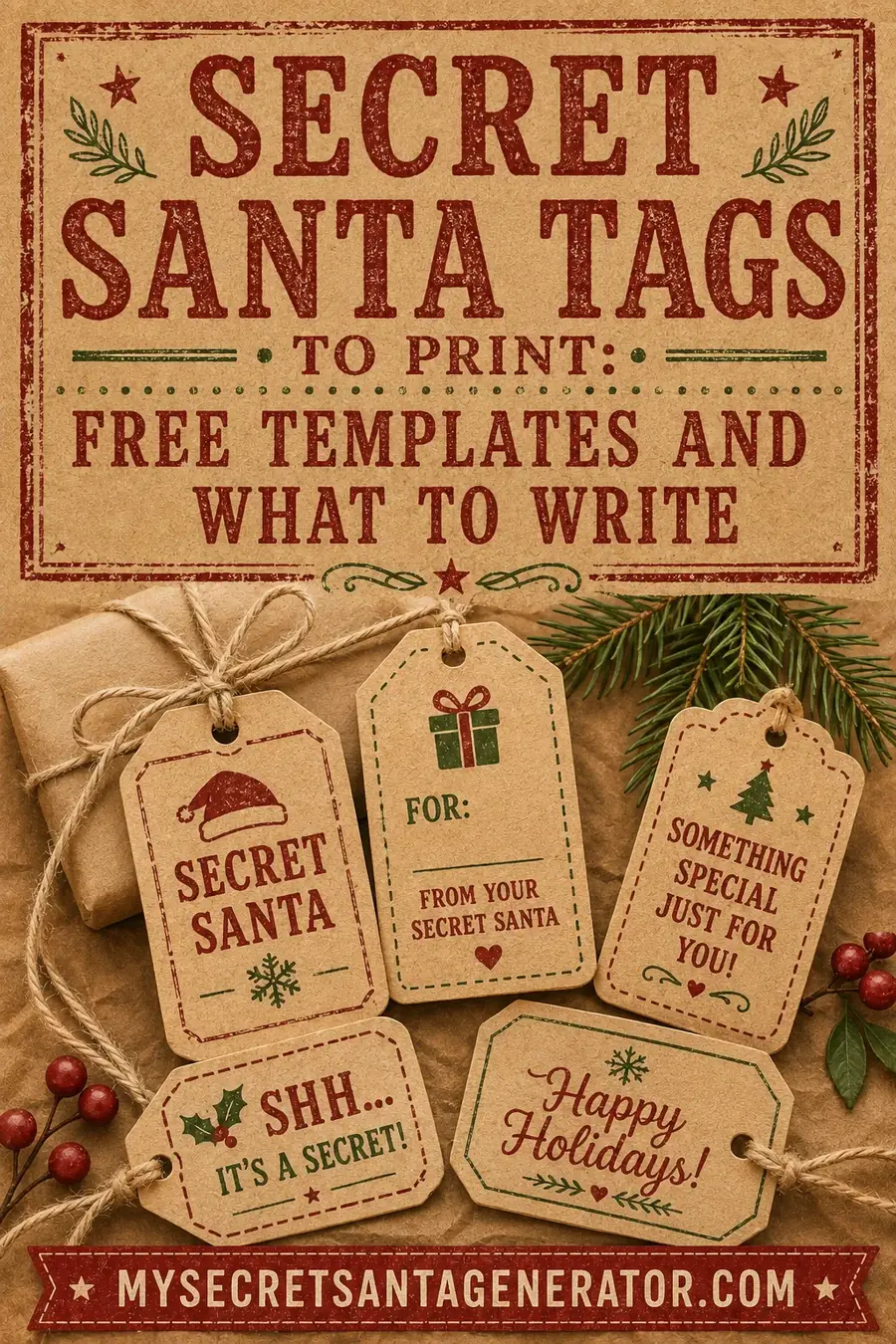
Printable secret santa tags need exactly two pieces of information — who the gift is for, and nothing that reveals who it's from. That second part is where most homemade tags go wrong: handwriting, inside jokes, or wrapping paper choices accidentally give away the giver before the reveal. Get the tag design and wording right and the tags do their job quietly; get it wrong and half your group guesses their Santa by lunchtime.
What to Actually Put on a Secret Santa Tag
Three lines, maximum. More than that and you risk leaking clues.
- "To: [Recipient Name]" — always visible, no ambiguity
- "From: Your Secret Santa" — never the actual name
- An optional short line — "Hope you love this!" or a small themed message. Skip this line entirely if your group has a strict no-clues rule, since even phrasing style can be recognizable.
That's it. Resist the urge to add a hint, a joke only you and the recipient would get, or anything referencing a shared memory — all three are the most common ways people accidentally reveal themselves.
Blank Tags vs. Pre-Filled Printable Sets
Blank tags (just "To: ___ From: Your Secret Santa" with a line to fill in) are the safer default. They let every gift look visually identical regardless of who wrapped it, which matters more than people expect — if your tags are pre-printed but everyone's handwriting is visible, handwriting alone can give someone away in a group where people know each other's writing.
Pre-filled or typed tags solve the handwriting problem entirely. Type the recipient's name in a shared font (or have one neutral person print and cut all the tags) so no individual's handwriting appears anywhere. This is the strongest anonymity option for small offices or friend groups where handwriting recognition is a real risk.
Themed printable sets (Santa hats, snowflakes, plaid patterns) are widely available for free from craft and printable sites, or you can generate simple ones in any word processor with a text box and a border. The visual theme doesn't affect anonymity either way — it's purely aesthetic.
How to Print Them Without Giving Anything Away
The actual printing step is where anonymity most often breaks down in a group setting:
Print in one batch, not individually. If everyone prints their own tag on their own printer, printer quirks (a slightly different shade of white, a faint streak, a particular font default) can become a tell. One person printing the whole batch and distributing them blank removes this risk entirely.
Use plain printer paper unless the whole group is using the same cardstock. A tag on noticeably nicer paper than everyone else's stands out.
Cut with the same tool. Scissors vs. paper cutter leaves different edges. If one gift has laser-straight tag edges and everyone else's are hand-cut, that's a small but real clue in a sharp-eyed group.
A Simple DIY Tag You Can Recreate in Any Word Processor
If you don't want to search for a template, this format takes under two minutes to build:
- A rectangle text box, roughly 3 inches by 2 inches
- Centered text: "🎅 To: _____"
- Below it: "From: Your Secret Santa"
- A thin border or a simple corner decoration (a small snowflake or holly icon from your program's symbol library)
- Print 6–8 per page, cut along the borders
Duplicate the box across the page, adjust only the "To" line for each recipient, and print the full sheet at once.
What About Digital or Virtual Secret Santa?
If your exchange is remote or shipped rather than handed over in person, a physical tag doesn't always apply — but the anonymity principle still does. Use a generic shipping label with just the recipient's name and address, no return address, or a return address that's a shared office or a neutral drop point rather than an individual's home. Many people running virtual exchanges skip physical tags entirely and instead assign names through a free secret santa generator that emails each giver their match privately, so the "tag" information never has to be written down or printed at all.
Mistakes That Blow the Anonymity Tags Are Supposed to Protect
Writing in a hurry, in your normal handwriting, in front of the group. If you fill out a tag while others can see you, the "who wrote this" question is answered on the spot regardless of what the tag says.
Using a nickname only one specific relationship uses. "From: Your Secret Santa 😉" reads fine, but a very specific emoji habit, a signature phrase, or an inside joke embedded in the optional message line is often the actual giveaway, not the handwriting.
Wrapping in paper you're known for using. This isn't about the tag itself, but it's the same anonymity problem — if you always use the same wrapping paper roll every year, people learn to recognize it regardless of what the tag says.
Design Ideas That Still Protect Anonymity
Keeping a tag anonymous doesn't mean it has to look plain. There's a real difference between visual style (which is completely safe to make distinctive) and content (which needs to stay generic). A few ways to make tags feel special without compromising the "from" line:
Lean on color and pattern, not personalization. A tag printed on festive plaid, a snowflake motif, or a bold color scheme reads as thoughtfully chosen without revealing anything about who selected it — especially if the whole batch uses the same handful of pre-approved designs so no single tag stands out as "obviously someone's personal taste."
Use a shared stamp or sticker instead of individual handwriting for the decorative element. A small Santa hat sticker or a wax-seal-style stamp applied uniformly to every tag in the batch adds a polished, consistent look without any single gift's tag revealing individual style choices.
Consider a numbered system instead of names for very security-conscious groups. Some larger office exchanges assign each participant a number instead of using names on tags at all, cross-referenced only in a private master list the organizer keeps — an extra layer of anonymity for groups where even a first name might tip someone off based on known relationships or seating charts.
What to Do If Anonymity Breaks Down Anyway
Even with the best tag design, some groups end up with an obvious guess or two by the day of the exchange — someone's giveaway laugh when their giver is opening the reveal, a gift so specific to an inside joke that only one person could have known. This is normal, and it's worth deciding in advance how your group wants to handle it. Some groups treat early guesses as part of the fun and let the reveal happen naturally in conversation. Others prefer a strict "no guessing out loud until everyone's gifts are opened" rule to preserve the moment for as many people as possible, even if a few individual matches become obvious along the way. Setting this expectation before gifts start getting opened avoids an awkward moment where one enthusiastic guesser spoils it for everyone else mid-exchange.
Printing Logistics for Larger Groups
For an office exchange or any group above about 15-20 people, printing tags efficiently becomes its own small project worth planning for. Most standard printer paper fits 6-8 tags per sheet at a reasonable size, so a 30-person exchange needs roughly 4-5 sheets total if one person handles the full batch. Doing this centrally (one person printing everyone's tags from a shared name list) rather than asking each participant to print their own tag is both faster and, as covered above, better for anonymity, since it removes any individual printer or paper variation from the equation entirely.
Coordinating Tags Across a Multi-Location Group
Remote or hybrid exchanges — a company with several offices, a family spread across different cities shipping gifts directly — add a wrinkle that simple in-person tag advice doesn't cover. When gifts are shipped rather than hand-delivered, the shipping label itself becomes part of the anonymity question, since a printed return address or a recognizable handwriting on a customs form can undo all the careful work put into the gift tag itself. The safest approach for shipped exchanges: have participants use a shared account or service that hides the sender's return address, or route everything through one central organizer who repackages and reships items so no individual address ever appears on the outer packaging. This adds a logistical step, but for a group that's serious about the reveal staying a surprise until the actual event, it closes the single biggest anonymity gap that pure tag design can't fix on its own.
Making Tags Part of a Bigger Unboxing Moment
For exchanges that include a group reveal event — everyone opening gifts together rather than privately — the tag can do more than just identify the recipient. Some groups add a small twist: printing a short riddle or a set of three vague clues about the giver's identity on the back of the tag, revealed only after the recipient guesses (or fails to guess) who their Santa was. This adds a layer of gentle fun to the reveal without compromising anonymity beforehand, since the clues are only readable after the gift itself is already open. It's a small addition that costs almost nothing to implement but noticeably raises the energy of a group reveal, especially for exchanges that have run the same straightforward format for several years and could use a bit of fresh structure.
Storing and Reusing Tag Templates Year to Year
If your group runs the same exchange annually, it's worth saving whatever tag template or design you land on rather than starting from scratch each December. A consistent tag design becomes a small recognizable tradition in itself — some long-running office and family exchanges have used the same basic tag design for years, updating only the year printed on it, which participants come to associate specifically with that group's holiday tradition. Keeping a simple digital file (even just a saved document with the layout ready to go) means next year's organizer only needs to update names, cutting the annual setup time down to a few minutes.
Group Size: Odd Numbers, Small Groups, and What Actually Matters
A surprising amount of worry goes into group size, and almost none of it is necessary. A Secret Santa draw is a one-way chain, not a set of pairs: everybody gives to one person and receives from one person, and the chain closes on itself. Nothing about that requires the number of people to divide evenly by anything.
So, can you do secret santa with odd number groups? Yes, with no adjustment at all. Seven people form a chain of seven exactly as easily as eight form a chain of eight. Can you do secret santa with 7 people, or can you do secret santa with 5 people? Both work, and five is a perfectly normal size for a family or a small team.
Do you need an even number for secret santa? No - and the belief that you do comes from confusing Secret Santa with a straight gift swap, where two people trade directly with each other and an odd person really is left over. Secret Santa has no pairing step, so that problem never arises.
The only real floor is three. With two people, there is only one possible assignment and both of you know it instantly, which removes the entire point. Above three, the practical limits are budget and logistics rather than arithmetic - and the tags are where a larger group needs the attention, because that is where a wrong name actually breaks something.
Printable Sign-Up Sheets and Questionnaires
Tags are the last piece of paper in an exchange. Two earlier ones do most of the work of making the gifts good.
The sign-up sheet. A secret santa sign up sheet is just a table pinned somewhere visible with four columns: name, contact, whether they are in, and whether they have paid or drawn. Its real job is to fix the participant list before the draw, because someone joining after names are pulled means redoing the whole chain. Set a closing date on the sheet itself and hold to it.
The questionnaire. A work gift exchange secret santa questionnaire is the single highest-value printable in the whole process. Six to eight short prompts is plenty: favorite drink, a snack you would never turn down, a color you actually wear, a hobby, something you have been meaning to replace, allergies or things to avoid, and one line for a specific item under the budget. Collect them before the draw, then hand each Santa the sheet belonging to their person.
Keep the collection anonymous in the right direction. The coordinator sees who wrote what, the Santa sees only the sheet for their recipient. If you use a secret santa fill out form online rather than on paper, turn off any setting that shows respondents to each other, and print each response separately so nothing gets passed around by accident.
What to Write in a Secret Santa Card
A tag carries a name; a card carries a tone, and it is where most people freeze. What to write in a secret santa card comes down to three lines and one rule.
Line one: greet without identifying. "To Priya," is enough. Skip anything that narrows the field - no references to a conversation only two of you had, no inside joke that has one obvious author.
Line two: say why you chose the gift. This is the line that turns an object into a gift. "You mentioned you were out of good coffee" or "This seemed like your kind of ridiculous" does more than any amount of decoration. Keep it general enough that it does not fingerprint you.
Line three: sign off warmly and anonymously. "Happy holidays - your Secret Santa" is the standard for a reason.
The rule: write it in block capitals or print it, or have someone outside the exchange write it, if handwriting is recognizable in your group. In a small office it usually is. If you want to say something more personal, save it for after the reveal, when you can say it as yourself rather than encoding it into a card and hoping nobody works it out early.
Frequently Asked Questions
Do secret santa tags need to say "secret santa" specifically?
No — "From: Your Secret Santa," "From: Santa," or even just a blank "From:" line all work. What matters is that it doesn't reveal an actual name, not the specific wording used.
Can I make gift tags without a printer?
Yes — a folded index card or a cutout from plain cardstock works exactly the same as a printed tag, as long as the same anonymity rules apply: no individually recognizable handwriting if that's a risk in your group, and no personal details in the message line.
Should the tag include a hint about what's inside the gift?
Only if your group has agreed to play with hints as part of the fun. Otherwise skip it — a specific hint is often more revealing of the giver's personality or interests than people realize.
What size should a printable secret santa tag be?
Roughly 2 to 3 inches on the longest side is standard — big enough to read the name clearly, small enough that 6-8 tags fit comfortably on one printed sheet.
Can I use the same tag design every year for a recurring exchange?
Yes — many groups intentionally reuse a consistent tag design year to year, updating only the printed year, which becomes a small recognizable tradition for the group over time.
Is it okay to use a store-bought generic gift tag instead of a secret santa-specific one?
Absolutely — any blank "To/From" tag works perfectly well as long as the "From" line stays anonymous; there's nothing special required about a tag beyond the anonymity principle covered above.
Do virtual secret santa exchanges need a tag equivalent at all?
Not necessarily — for shipped or virtual exchanges, the recipient's name and a general "From your Secret Santa" note in a card or digital message serves the same function a physical tag would in an in-person exchange.