Secret Santa Wish List Ideas: What to Actually Put on Yours
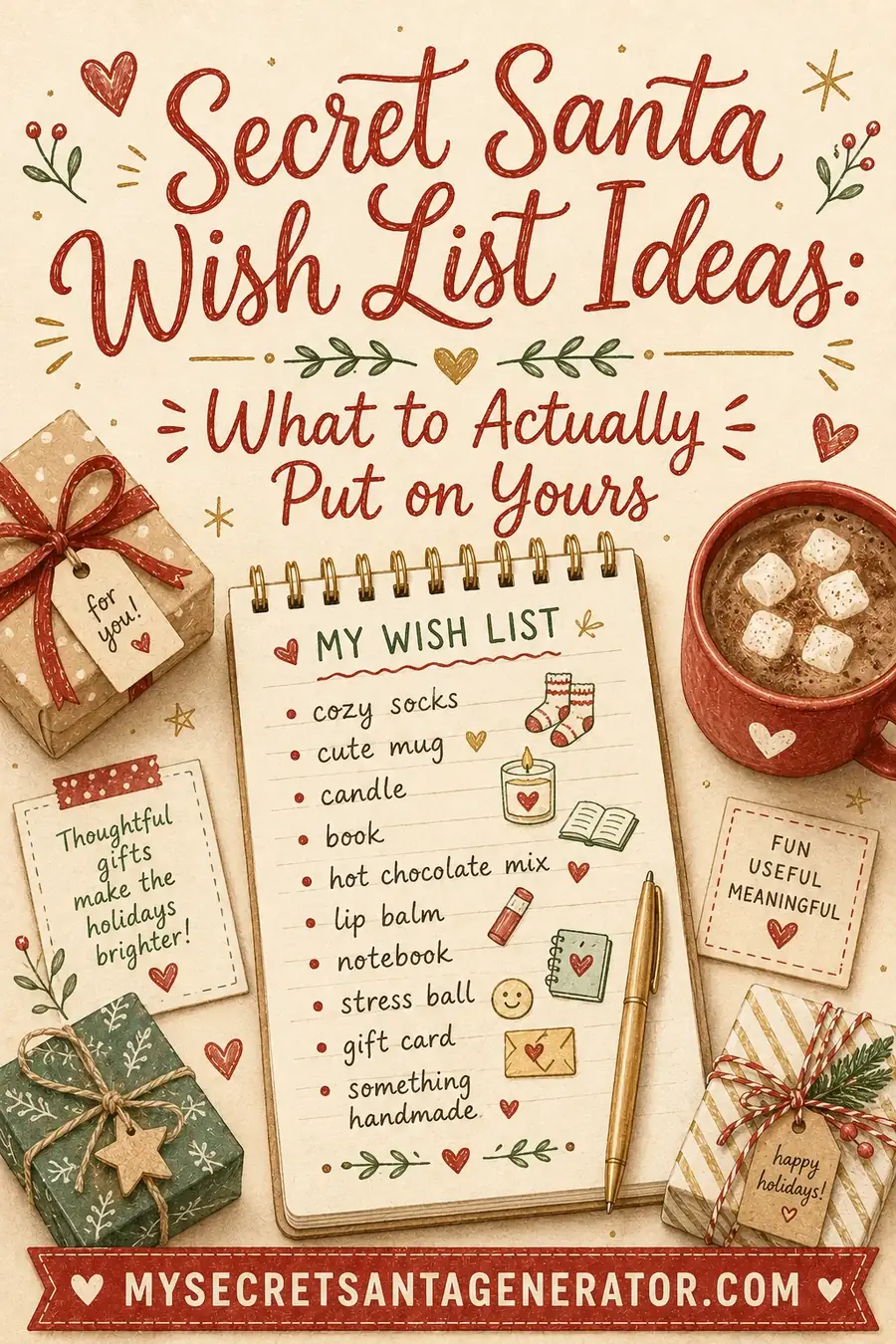
A good secret santa wish list has 8-10 specific items across a range of prices, not one expensive thing you're hoping for. The person who draws your name is usually a coworker, a distant family member, or someone you don't know well enough to shop for confidently — your wish list is the single biggest thing you control that determines whether you get a gift you'll actually like.
Why "Surprise Me" Is the Worst Answer
When someone asks what you want and you say "anything, surprise me," you're not being easygoing — you're transferring all the risk onto someone who often has a $20-25 budget and no idea what you're into. The result is usually a scented candle, a mug, or a gift card, because those are the only safe options left when no information is given.
A specific list does the opposite: it turns a stressful guessing game into a simple shopping list. Your giver picks whichever item fits their budget and moves on with confidence.
The Ideal Wish List: 8-10 Items Across Price Ranges
Structure your list in three tiers so it works no matter what your Santa's exact budget turns out to be:
Under $10 (2-3 items): Small, specific, low-risk. A particular flavor of coffee, a favorite brand of hand cream, a specific paperback you've been meaning to read, fun socks in a color/pattern you actually like.
$10-25 (3-4 items): The sweet spot for most office and friend exchanges. A specific book, a board game you don't own, a nice water bottle or mug (if you actually want one — don't default to this out of habit), a gift card to a specific coffee shop or bookstore near you.
$25+ (2-3 items): For exchanges with a higher budget or in case your Santa wants to go slightly over. A specific kitchen tool, a piece of clothing with size/color noted, a hobby-specific item (art supplies, a specific game expansion, gardening tools).
Specific Beats Generic Every Time
"A candle" is generic. "A candle in a fall scent like pumpkin or cedar, not floral" is specific and takes ten extra seconds to write but massively increases your odds of liking what you get. The same logic applies everywhere on your list:
| Too generic | Better |
|---|---|
| A book | A mystery or thriller novel, paperback preferred |
| Coffee | Dark roast whole bean, local roaster if possible |
| Socks | Wool hiking socks, size 9-11 |
| A game | A 2-player board game under 45 minutes, no trivia |
| Skincare | Unscented moisturizer, sensitive skin |
Specificity isn't about being demanding — it's about removing guesswork so your Santa can shop confidently instead of anxiously.
Ideas by Interest, If You're Stuck
If you like to cook: a specific spice blend, a kitchen gadget you've mentioned wanting, a cookbook for a cuisine you're into, a nice apron.
If you're into fitness: a resistance band set, a specific water bottle brand, workout socks, a gym bag accessory.
If you read a lot: a bookmark, a specific genre paperback, a small book light, a bookstore gift card.
If you're a plant person: a small planter, plant food, a specific easy-care plant (pothos, succulent), plant-themed stationery.
If you work from home: a desk plant, a nice pen, a mouse pad, blue-light glasses, a specific mug (if you actually drink from mugs at your desk).
If you're hard to shop for: lean harder into experiences and consumables — a specific snack you love, a gift card to somewhere you actually go, a small subscription box for one month.
What to Leave Off Your List
Anything that requires knowing your exact size in a category that varies by brand, unless you specify the brand too. "A sweater" with no size or style guidance is a near-guaranteed miss.
Expensive single items with no cheaper backup. If your whole list is one $150 item, a $20-budget Santa has nothing they can actually buy, and you'll likely end up with a random substitute instead.
Anything you'd be embarrassed to receive in front of the group, if your exchange includes an unwrapping event. Save purely personal items for a list you'd share one-on-one, not a group exchange.
Inside jokes or vague pop-culture references that only make sense to people who know you well — remember, your Secret Santa in an office exchange might be someone you've spoken to twice.
How and Where to Share Your List
Keep it somewhere your Santa can actually find it without asking around and blowing their own cover. Options that work well:
- A shared spreadsheet or sign-up sheet where everyone lists their own wishes next to their name (works great alongside a secret santa sign up sheet)
- A private note field in whatever tool you used to draw names, if your generator supports it
- A group chat pinned message everyone can add to, without names attached to specific requests if you want to preserve some mystery
The goal is simple: your Santa should be able to find your list without asking you directly, which would spoil part of the fun.
Writing a Wish List When You Genuinely Want to Be Surprised
Some people don't actually want a fully specified list — part of the fun of an exchange, for them, is the element of genuine surprise. If that's you, there's a middle-ground approach that still helps your Santa without spelling out exactly what you'll receive: list categories and boundaries instead of specific items. "I love cozy home things, anything coffee-related, and books in the mystery/thriller genre — surprise me within those lanes" gives your Santa real direction while preserving the surprise of exactly what they pick. This works especially well for people who find a fully itemized list a little joyless, without dumping the entire guessing burden back onto an under-informed giver.
What Your Wish List Says Beyond the Items Themselves
A well-built wish list does something subtle beyond just naming gifts: it signals to your Santa what kind of gift-giver you'd appreciate being paired with. A list heavy on specific, practical items (a particular kitchen tool, a specific book title) tells your Santa you value precision and usefulness. A list built more around categories and vibes ("cozy," "adventurous," "nostalgic") signals you're comfortable with your Santa exercising some personal judgment and creativity. Neither approach is more "correct" — but being aware of which style you're naturally writing helps you catch yourself if your list doesn't actually match what you want from the experience. Someone who secretly wants a thoughtful, personalized gift shouldn't write a list of Amazon links with no room for interpretation, and someone who wants zero risk of an off-target gift shouldn't leave things too vague.
Updating Your List as the Exchange Approaches
If your exchange has a multi-week window between the name draw and the actual gift exchange, it's worth treating your wish list as a living document rather than something you write once and forget. A quick update a week or two before the deadline — removing an item you already bought yourself, adding something new you've been wanting, adjusting a size or preference — costs almost nothing and meaningfully improves your odds of a gift you'll actually love, especially if your Santa is someone who checks back closer to the deadline rather than shopping the moment names are drawn.
A Sample Wish List, Fully Filled Out
To make the structure above concrete, here's what a complete, well-built wish list actually looks like in practice:
- Under $10: A bag of dark roast coffee beans (local roaster preferred), wool blend socks (size 9-11, any color but pink)
- $10-25: "The Thursday Murder Club" paperback or similar cozy mystery, a $20 gift card to [specific local coffee shop], a two-player board game under 45 minutes (no trivia format)
- $25+: A cast iron skillet (10-inch), a nice desk plant with a simple ceramic pot, noise-canceling earbuds (any brand, under $60)
This kind of list takes under ten minutes to write and removes almost all the guesswork for whoever draws your name, regardless of their budget.
Writing a Wish List for Someone Else (When You're the Coordinator)
Sometimes the person filling out the wish list isn't the recipient themselves — a parent filling one out on behalf of a young child, or an office coordinator gathering preferences for someone new who hasn't had time to submit their own. In these cases, the goal shifts slightly: rather than writing from personal knowledge, you're gathering it. A short set of standard questions works well for this — favorite snack or drink, a hobby or interest, a color or style preference, and one thing to specifically avoid (an allergy, a strong dislike). This produces enough of a wish list for a Santa to work from, even without the depth a self-written list would have, and it prevents the common fallback of a completely generic gift for anyone who didn't get a chance to fill out their own preferences in time.
What a Thoughtful Santa Does With a Vague or Missing List
Not every participant fills out their wish list, no matter how much organizers encourage it — this is a near-universal reality of group gift exchanges. If you draw someone who left theirs blank or wrote only "surprise me," the best fallback isn't panic-buying a candle at the last minute. A quick, low-pressure check-in with a mutual friend or coworker ("hey, any idea what [name] is into lately?") often surfaces more useful information in two minutes than an empty wish list ever would. Barring that, defaulting to broadly safe, high-quality consumables — good coffee, a nice snack assortment, a cozy pair of socks — tends to land better than an impersonal gift card, since it at least signals some thought went into the choice even without specific guidance.
The Etiquette of Updating Someone Else's Wish List Expectations
If your group uses a shared spreadsheet or sign-up sheet where wish lists live publicly, it's worth setting a light expectation early that lists can be edited right up until a set cutoff date, rather than treated as locked the moment they're first written. This removes the pressure to get it perfect on the first try and encourages people to actually use the list as intended — jotting something down quickly at first, then refining it once they've had a chance to think it over. A simple reminder message a week before the deadline ("last call to update your wish list!") is often all it takes to get people to add a few more specific, useful details before their Santa starts shopping in earnest.
Things to Ask For for Secret Santa When You Draw a Blank
The hardest part of writing a list is the blank page, so stop trying to think of gifts and start auditing your own week instead. Almost every good entry comes out of one of five buckets.
Something you use daily and have not replaced. A worn wallet, a dead water bottle, a cheap phone stand, socks with holes in them. These make excellent gifts precisely because you would never buy them for yourself.
Something consumable you already buy. Coffee beans, a specific hot sauce, a candle scent, good chocolate, a tea you ration. Nobody has ever regretted receiving a thing they were going to purchase anyway.
Something one tier above what you would pay. The nicer notebook, the better pen, the real olive oil. This is where the best gifts in most exchanges come from.
Something for a hobby you already do. Not a hobby you intend to start - the intention gifts are the ones that end up in a closet.
A gift card with a specific store named. Less exciting, but honest.
A Christmas secret santa wish list built this way is faster to write and far easier to shop from than one built by trying to imagine what you want in the abstract. Write down eight things to ask for for secret santa from those buckets and you are done in ten minutes.
Weird, Funny, and Deliberately Silly Picks
Some groups run a straight exchange and some run one where the whole point is the reaction. If yours is the second kind, the list changes shape completely.
The rule that makes weird secret santa presents work is that the joke has to have a second life. A gift that gets a laugh and then goes in the trash on the way out of the office is a wasted budget; a gift that gets a laugh and then sits on somebody's desk for two years is the actual goal. A mug with an absurd but genuinely usable design, a wildly specific novelty sauce, a small ugly lamp - these clear that bar. Printed jokes on a T-shirt and gag items that need explaining generally do not.
The second rule is that hilarious secret santa presents should be funny to the recipient, not only to you. In-jokes about a person's habits land well when the person likes the habit and badly when they are self-conscious about it, and you often cannot tell which from the outside. Aim the joke at a shared situation - the office coffee machine, the group chat, the thing everybody complains about - rather than at an individual's quirk.
Fun presents for secret santa in the safest sense are the ones with a small element of play: a desk puzzle, a decent card game, a tiny plant with a ridiculous name, something noisy that is not too noisy.
Cool, Good, and Genuinely Wanted
For a straight exchange, the entire skill is spending a modest budget on something specific rather than something generic.
Cool presents for secret santa nearly always share one quality: they look like an object somebody chose, not an object somebody grabbed. A single good-quality item beats a basket of small ones almost every time. A heavy pen, a well-made keychain, one excellent bar of chocolate, a small print, a proper pair of thick socks in a real color. The whole effect comes from the item being deliberate.
Great secret santa presents usually add a second quality on top: they show you paid attention. If someone mentioned a book they were meaning to read, a city they lived in, or a drink they like, that detail is worth more than the price tag. Good secret santa presents do not require you to know somebody well - they require you to have listened once.
Low cost secret santa gifts are their own discipline, because most exchanges cap at fifteen or twenty dollars. At that level, the reliable strategy is to buy the best version of a small thing rather than a cheap version of a big thing. Good coffee beats a bad gadget. One nice notebook beats a set of three plain ones. And a genuinely thoughtful five-dollar item is remembered longer than a forgettable twenty-dollar one.
Lists for Specific People
Certain recipients come up again and again, and each one has a predictable failure mode.
Guys. The trouble with the phrase secret santa presents for guys is that it invites the default aisle - novelty bottle openers, grill tools, sports-branded anything - and everybody has already received all of it. Cool secret santa gifts for guys work the same way they work for anyone: a specific hot sauce set, a good multitool, a decent beanie, headphone-cable clutter solved, a book by an author they have actually mentioned. Buy for the person, not the category.
Coworkers. Secret santa gift ideas for co workers have one extra constraint: you will see this person every day afterward. That rules out anything that comments on appearance, anything remotely political, and anything that implies you know more about their personal life than you do. Desk-usable, consumable, and neutral is the winning combination - good snacks, a plant that survives fluorescent light, a nice mug, a gift card to the coffee place downstairs.
Adults-only exchanges. Adult secret santa presents in the sense of a grown-up rather than a family exchange usually means the budget is higher and the joke tolerance is different. Confirm both before shopping, because the gap between what a friend group finds funny and what a workplace finds funny is where nearly every Secret Santa horror story comes from.
Frequently Asked Questions
How many items should be on a secret santa wish list?
8-10 items is the sweet spot — enough that your Santa has real options across different price points, not so many that the list feels overwhelming or impossible to narrow down.
Is it rude to include price ranges on a wish list?
No — it's actually the most helpful thing you can do. It removes the guesswork about whether an item fits the budget and prevents both underspending and accidentally going over.
What if I genuinely can't think of anything I want?
Default to consumables and small comforts: a specific snack, a specific candle scent, a coffee shop gift card, cozy socks. These are nearly impossible to get "wrong" and don't require deep personal knowledge to buy.
Should I include a link to the exact item?
If your exchange allows it, yes — a direct link removes all ambiguity about color, size, or version. If your group prefers a more surprise-friendly format, a clear written description with size/color noted works almost as well.
Should a secret santa wish list include a budget range if the exchange doesn't have one set?
Yes, it's a helpful addition even without a formal group budget — noting a rough comfortable range for each price tier on your list helps your Santa gauge appropriate spending without needing to ask around.
Is it rude to update my wish list after someone may have already started shopping?
Not inherently, though it's courteous to make major changes early in the exchange window rather than right before the deadline — a small addition or removal close to the date is usually fine, but swapping your entire list late can leave your Santa without enough time to adjust.
What's a good secret santa wish list item for someone who says they "don't need anything"?
Lean into small comforts and consumables rather than trying to guess at a "need" — a specific favorite snack, a cozy item, or a coffee shop gift card work well for people who are genuinely hard to shop for precisely because they don't want or need much.