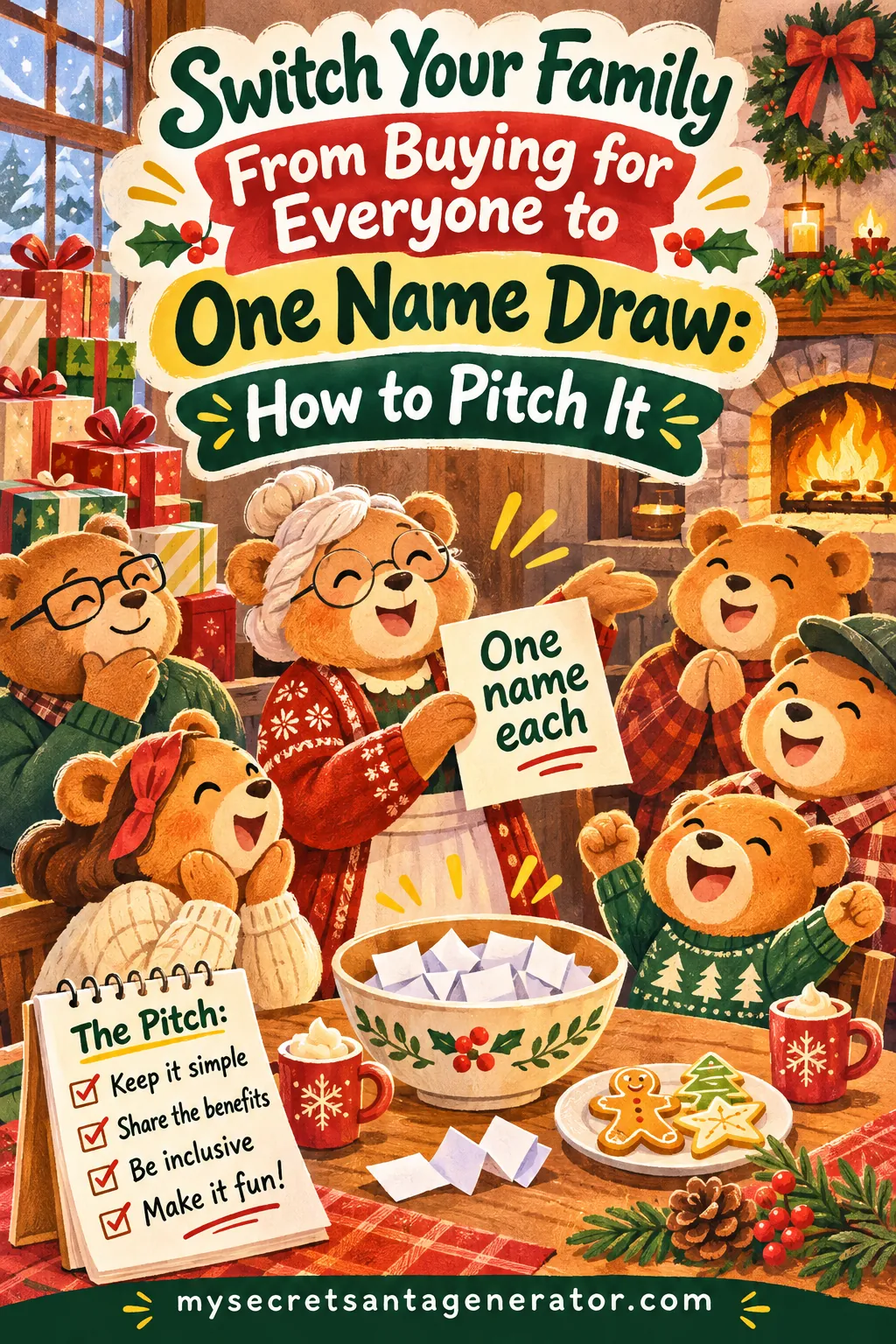
Switch Your Family From Buying for Everyone to One Name Draw: How to Pitch It
The easiest way to move your family to a secret santa instead of buying for everyone is to pitch it as a one-year trial for the adults only, keep the kids' gifts exactly as they are, and show up with the plan already built: one name each, one spending cap, couples kept apart, and names drawn by mid-November. When people can see that nobody gets left out and the children still get their stack, most of the pushback melts away. You can run the whole draw in a couple of minutes with the free Secret Santa Generator, which needs no accounts or emails and keeps spouses from drawing each other.
This guide walks you through the math that makes the case, the exact words to use when you bring it up, how to answer the relatives who love the old way, and a step-by-step setup in the generator. It's written for the person who's tired of the December gift scramble but doesn't want to start a family feud over it.
🎁 Quick Secret Santa Name Draw
Type everyone's name (one per line), then draw. Nobody gets themselves. Each person taps their own name to see who they're buying for.
Why Buying for Every Adult Stops Working
Buying a gift for every adult in the family usually starts when the family is small. Two siblings and their parents trade presents, and it feels easy. Then people marry, partners join, cousins grow up and bring their own partners, and before long the "small" family list has twelve adults on it.
The trouble is that the number of gifts doesn't grow in a straight line. It grows much faster than the number of people.
Here's the simple math. If everyone buys for everyone else, each person buys for every adult except themselves. So the total number of gifts is the number of adults times one less than that number.
| Adults in the family | Gifts each person buys | Total gifts exchanged | Total with one name draw |
|---|---|---|---|
| 4 | 3 | 12 | 4 |
| 6 | 5 | 30 | 6 |
| 8 | 7 | 56 | 8 |
| 10 | 9 | 90 | 10 |
| 12 | 11 | 132 | 12 |
| 15 | 14 | 210 | 15 |
Look at the jump from 8 adults to 12. Four more people at the table means 76 more gifts changing hands. Every one of those gifts is a shopping trip, a guess about what someone wants, a wrapping session and, often, a gift that ends up in a closet.
A name draw flattens that curve. Each adult buys for one person. Twelve adults means twelve gifts, not 132.
What people actually feel under buy-for-all
When families finally talk about switching, the same feelings come up again and again:
- Shopping fatigue. Picking eleven thoughtful gifts in a few weeks is hard, so most of them end up being rushed.
- Gift guessing. You don't really know what your brother-in-law's partner likes, so you buy something generic.
- Uneven budgets. One sibling has more room in their budget than another, and the gap shows on the gift table.
- Clutter. Lots of small, forgettable things pile up in everyone's homes.
- Time. December weekends go to shopping and wrapping instead of being together.
A name draw doesn't fix every holiday stress, but it fixes these. One person, one gift, picked with care. That's the heart of what you're going to pitch.
What the Name Draw Actually Looks Like
Before you pitch anything, be clear in your own head about what you're proposing. A vague "let's do less" invites a vague "no." A specific plan is much easier to say yes to.
Here's the plan that tends to work for families switching for the first time:
- Adults only. Every adult (usually anyone who's out of school or living on their own) goes into one draw.
- Kids stay out of the draw. Parents, grandparents, aunts and uncles keep buying for the children the way they always have. Nothing changes for them.
- One name each. Every adult draws one other adult and buys one good gift for that person.
- Couples can't draw each other. Spouses and partners already buy for each other, so they're blocked from matching.
- One spending cap. The family agrees on a single amount, so the gifts feel even.
- Wish lists. Each adult adds a few ideas so the giver isn't guessing.
- Names drawn by mid-November. That leaves about five weeks to shop, make or mail the gift.
- A one-year trial. You'll check in after the holiday and decide together whether to keep it.
That last point does a lot of work. People resist permanent change far more than they resist trying something once. "Let's try it this year" is a much smaller ask than "let's change Christmas."
What stays exactly the same
Make a short list of what doesn't change, because that's what people are quietly worried about:
- The kids still get gifts from everyone who wants to give them.
- Couples still exchange gifts with each other.
- Grandparents can still buy for anyone they want (more on that below).
- The family meal, the traditions and the gathering all stay the same.
- Stocking stuffers, homemade cookies and small family-wide treats are still welcome.
When you lead with "nothing changes for the kids" and "this is just for the adults," you're answering the biggest objection before anyone has a chance to raise it.
How to Do It With the Free Tool (Exact Settings)
Having the draw ready to go makes your pitch stronger. You can say, "I've already set it up. If everyone's in, I just press the button." Here's how to do that in the free Secret Santa Generator.
Step 1: Name your exchange
Open the generator and tap Draw Names Now. On the first screen you'll see these fields:
- Event Name: use something warm and specific, like "Martinez Family Christmas Draw" or "Grandma's House Gift Exchange." A clear name helps people recognize the link later.
- Exchange Date (optional): enter the day you'll open gifts, usually Christmas Eve or Christmas Day.
- Your Name (organizer): add your first name.
- Gift Budget: pick the budget option that matches the cap your family agreed on. If you haven't agreed yet, see the budget section below before you draw.
- Theme (optional): the menu includes a Family Exchange theme. You can leave it blank or pick it so everyone sees the family framing.
- Message to Participants (optional): this note shows up when people reveal their match. It's a great spot for your house rules, like "Adults only, one gift each, please have it wrapped by Christmas Eve."
Then tap Add People.
Step 2: Add every adult, with couples kept apart
On the "Who's Joining the Fun?" screen, add one adult at a time:
- Name: first names are enough. If two people share a name, add an initial, like "Ana R." and "Ana M."
- Wishlist (optional): paste in the ideas each person sent you. Three to five items is plenty.
- Don't pair with: this is where couples get blocked. Pick the person's spouse or partner from the menu and tap + Add before you add the person.
There's one small thing to know about the order. The "Don't pair with" menu only lists people you've already added. So add the first partner of a couple normally, then add the second partner and pick the first one in the "Don't pair with" menu. The generator blocks the pair in both directions, so you only have to set it once per couple.
The generator needs at least three people. Most families switching from buy-for-all have six or more adults, so that's rarely an issue.
Step 3: Draw
Tap Draw Names, check the summary (event, date, budget, number of people, exclusions), and tap Draw Names Now! The generator shuffles until it finds a draw where nobody gets themselves and no blocked pair matches.
If you've added so many exclusions that no valid draw exists, it'll tell you so with a message asking you to reduce exclusions or add more people. With just couples blocked, that almost never happens. The one classic trap is a tiny group of three where two people are a couple: both partners would have to draw the third person, which can't work, so add at least one more adult.
Step 4: Get each person their match privately
Once the names are drawn, you have two ways to share:
- Share link: tap Generate, then Copy, and paste the link into your family group chat or a text to each adult. Each person opens it on their own phone, taps their own name and sees who they're buying for, along with that person's wish list and some gift ideas that fit the budget. It's an honor system, so add a line like "Only tap your own name!" when you send it.
- Reveal Here (Pass Device): if you're all together for a birthday or a Sunday dinner in November, pass one phone around and let each adult tap their name.
A quick word for the organizer: the generator also has an Organizer View that shows every match. If you want to keep your own surprise, simply don't open it. Tap your own name in the reveal like everyone else.
The generator saves your exchange in your own browser, so you can close the tab and come back later to grab the link again or print gift tags. It doesn't create accounts or send emails, which also means it won't send reminders for you. You'll do that part yourself with a quick text.
Step 5: Print tags for the big day (optional)
On Christmas Eve or whenever you open gifts, the Print Gift Tags option makes one tag per person in five designs (Classic, Winter, Glam, Cozy and Holly). Each tag shows who the gift is for and keeps the giver a mystery, which is handy if you want a guessing game at the table.
How to Pitch It Without Starting a Fight
Most family pushback isn't really about gifts. It's about feeling left out, feeling judged, or feeling like a beloved tradition is being taken away. A good pitch speaks to those feelings directly.
Pick the right moment and the right channel
- Talk to one or two key people first. Usually that's the person who hosts Christmas and the grandparent or parent whose opinion carries the most weight. If they're on board, everyone else tends to follow.
- Bring it up early. Late October to the first week of November is ideal. Once people have started shopping, they feel like their effort is being wasted.
- Avoid big group arguments. A busy group chat can turn one grumpy reply into a pile-on. A quick phone call or one-on-one message to each household often goes smoother, followed by a single group message once most people have said yes.
Lead with "we," not "I"
"I can't afford to buy for everyone" puts you on the spot and invites people to offer to cover you, which isn't what you want. "What if we all tried one good gift each this year?" makes it a shared idea that helps everyone.
Scripts you can copy
The warm group text:
"Hi everyone! I've been thinking about how much running around we all do in December. What if the adults tried a name draw this year? Each of us draws one name and gets that person one really good gift, with a set limit so it's even. Kids stay the same, everyone still buys for them. Couples won't draw each other. If we hate it, we go back next year. Thoughts?"
For the host or the family elder (one-on-one):
"Can I run something by you before I ask everyone else? I'd love to try a name draw for the adults this year so we spend less time shopping and more time together. The kids would still get everything from everyone. Would you be open to it? I think if you like it, the others will too."
For the relative who's on a tight budget (and you know it):
Don't mention their budget at all. Just make sure the cap you propose is comfortable for everyone. People notice when a plan is clearly built around them, and it can feel embarrassing. A family-wide cap protects them without singling them out.
For the person who loves shopping for everyone:
"I know you love picking gifts for all of us, and you're so good at it. With a draw, you'd get to go all-out on one person instead of rushing through ten. And you can still spoil the kids as much as you want."
When you've already set it up:
"I put everyone into a free draw tool already, with couples blocked so nobody gets their own spouse. If you're all in, I'll press the button this weekend and send the link. Everyone taps their own name to see who they got."
Answering common objections
You'll hear some version of these. Here's a calm reply for each.
| What they say | What's usually behind it | A calm reply |
|---|---|---|
| "But I like buying for everyone." | They enjoy giving and don't want to lose that joy. | "You can still go all-out on your person, and on the kids. This just takes the pressure off the rest of us." |
| "It feels cheap." | Worry about looking stingy or ungrateful. | "It's the opposite. One gift chosen with care usually means more than ten rushed ones." |
| "What if I draw someone I don't know well?" | Fear of picking a dud gift. | "Everyone adds a wish list, so you'll have ideas right there with the name." |
| "Grandma won't like it." | Respect for the elder's traditions. | "Let's ask her first. If she wants to keep buying for everyone, she can, and the rest of us still do the draw." |
| "We've always done it this way." | Tradition and identity. | "Let's try it for one year and talk about it after. If it doesn't feel right, we go back." |
| "My kids will miss gifts from their aunts and uncles." | Worry the change spreads to children. | "Kids aren't in the draw at all. Everybody keeps buying for them like always." |
| "I already bought some things." | Feeling their effort was wasted. | "Keep them for your person, for the kids or for next year. No one's asking you to return anything." |
| "This is just because someone can't afford it." | Suspicion or judgment. | "It's for all of us. December is busy, and this gives everyone more time together." |
Let the grandparents choose
Grandparents often feel strongest about buying for everyone, especially for their grown children. A simple fix is to give them a choice:
- Join the draw like any other adult, or
- Stay out of the draw and keep giving to whoever they like, or
- Join the draw and still give small family-wide gifts, like a batch of cookies or an ornament for every household.
Offering a choice makes it clear the draw isn't a rule imposed on them. Most grandparents pick one of the options happily once they see their grandkids are untouched.
Setting a Spending Cap Everyone Can Live With
The cap is the part people argue about most, so settle it before you draw. A good cap is comfortable for the person with the tightest budget, not the person with the most room.
A few ways to land on a number without awkwardness:
- Ask privately. Send each household a quick message asking what amount would feel easy. Pick something at or a bit under the lowest answer.
- Anchor on the old total. If people used to buy ten gifts each, the new cap can be higher than any single old gift while still being far less in total.
- Agree on a range. "Somewhere around this amount, give or take a little" lets people relax if a perfect gift runs slightly over.
- Allow homemade. Say clearly that handmade gifts, baked goods and experiences (like a coffee date or a day of help with a project) are welcome.
Our guide on how much to spend on Secret Santa has more on picking a number that feels fair to a mixed group. Once you've agreed, choose the matching option in the generator's Gift Budget field so it shows up next to every reveal.
Why one cap matters more than the amount
With buy-for-all, gaps in budgets show up dozens of times across the gift table. With one name each and one cap, every gift is roughly equal. That's often the biggest relief for families where incomes are very different, and it's one of the strongest points in your pitch.
A Timeline That Gets Names Drawn by Mid-November
Timing matters as much as the pitch. If you wait until December, people have already started shopping for everyone, and switching feels like a waste. Aim to have every adult know their person by the middle of November.
| When | What to do | Why it matters |
|---|---|---|
| Late October | Talk privately with the host and the family elder | Their support makes the group conversation easy |
| First week of November | Send the group pitch and ask for a yes or no within a few days | Gives people time to think without dragging it out |
| By November 10 | Confirm who's in, agree on the cap, collect wish lists | You need all three before the draw |
| November 10 to 15 | Run the draw and send the share link | Everyone knows their person by mid-November |
| Late November | Send a friendly reminder and answer questions | Catches anyone who hasn't tapped their name yet |
| Early December | Remind anyone mailing a gift to check their carrier's official holiday shipping dates | Mailed gifts need extra time in December |
| A few days before Christmas | Final reminder: wrap it, tag it, bring it | Nobody shows up empty-handed |
| Christmas Day | Open gifts and enjoy the reveal | The payoff |
| Early January | Quick check-in: keep it, tweak it or drop it? | Turns the trial into a tradition, or not |
If you're reading this a little later in the season, don't worry. You can still run the draw in late November or early December. Just keep the plan simple, lean on wish lists and suggest gifts that are easy to find nearby or make at home.
Collecting wish lists without nagging
Wish lists are what make a name draw feel generous instead of random. Ask each adult to send you three to five ideas, plus anything they'd rather not get. Good prompts include:
- One thing you'd use every day
- One small treat you'd never buy yourself
- A hobby you'd love supplies for
- A favorite snack or drink
- Sizes, colors or styles you like
- Anything to avoid (allergies, clutter, scents)
Paste each list into the Wishlist field when you add that person in the generator. The giver sees it the moment they reveal their match. For more prompts, our Secret Santa wish list guide has plenty of ideas you can borrow.
Variations for Different Family Sizes and Situations
There's no single right way to do a family name draw. Here's how to adjust the plan for the family you actually have.
Small families (4 to 6 adults)
With only a few adults, the draw can feel a little predictable, and couples take up a big share of the list. Some tips:
- Keep couple exclusions, but check the numbers. Four adults in two couples works fine. Three adults with one couple doesn't, because both partners would need to draw the same single person.
- Consider adding a fun twist, like a theme (everything homemade, or everything cozy) so the gifts feel special even if people guess who drew them.
- If the draw feels too easy to figure out, skip the guessing game and just enjoy the gifts.
Medium families (7 to 12 adults)
This is the sweet spot for a name draw. You'll see the biggest drop in total gifts, and there are enough people that matches stay a surprise. Block couples, collect wish lists, and you're done.
Large families (13 or more adults)
Big families sometimes worry that the draw will pair cousins who barely know each other. A few fixes:
- Lean hard on wish lists so nobody's guessing.
- Split into two smaller draws by branch if people really prefer to give within their own side. Our guide to Secret Santa for two families walks through ways to set that up fairly.
- Use the Message to Participants field to remind everyone of the cap and the date, since large groups get more questions.
Blended families and in-laws
If your family includes stepparents, ex-partners who still come to Christmas, or two sets of in-laws, the draw can actually ease tension. Nobody has to decide who "deserves" a gift. Use exclusions for any pair who'd feel awkward exchanging gifts, as well as for couples. Our Secret Santa exclusions guide explains how to use them without making the draw impossible.
Families with young adults and teens
Decide where the line falls between "kid" and "adult." Common choices:
- Everyone who's finished high school joins the draw.
- Everyone who's 18 or older joins the draw.
- Teens can opt in if they want to, with the same cap as everyone else.
Whatever you pick, say it clearly in your pitch so no one feels left out or pushed in.
Families who live far apart
When some relatives won't be there in person, the share link becomes even more useful. Everyone reveals on their own phone, wherever they are. Ask people who will mail a gift to check their carrier's official holiday shipping dates early and to plan on sending it in early December. You can also agree that faraway relatives open their gift on a video call so everyone can share the moment.
Troubleshooting the First Year
Even a well-pitched draw hits a bump or two. Here's how to handle the common ones.
| Problem | What to do |
|---|---|
| Someone says no after everyone else agreed | Let them sit out. Run the draw with everyone who said yes. They can still buy for the kids. |
| A couple drew each other | That means the exclusion wasn't set. Go back to the participant list, add the "Don't pair with" block and redraw. Tell everyone to check the new link. |
| Someone joins late | Add them in the generator and tap Redraw. Everyone gets a new match, so send the fresh link and say clearly that the old matches no longer count. |
| Someone drops out after the draw | Remove them and redraw. If people have already bought gifts, ask the person who drew the dropout to swap with whoever drew the newest participant instead. |
| The draw says it can't find a valid match | Too many exclusions for too few people. Remove an exclusion that isn't essential or add another adult. |
| Someone tapped the wrong name | It's an honor system, so a redraw is the cleanest fix. Remind everyone to tap only their own name. |
| A relative keeps buying for everyone anyway | Let it go. Thank them warmly. The goal is less stress, not perfect rule-following. |
| Someone forgets their gift | Have the giver bring a card with a promise, like a lunch date in January. It still counts. |
Don't police it too hard
The point of switching is to make Christmas lighter. If Grandpa still wants to hand everyone a small envelope or your sister brings cookies for every household, that's part of the warmth. Keep the draw as the main event and let small extras happen naturally.
After Christmas: Turning the Trial Into a Tradition
The early-January check-in is where a one-year trial becomes a lasting habit. Keep it light. A short message works:
"Thanks for trying the name draw! Did you like it? Want to do it again next year, change anything, or go back to the old way?"
Things families often tweak in year two:
- Raise or lower the cap based on how it felt.
- Avoid last year's matches so nobody draws the same person twice in a row. You can do this by adding a "Don't pair with" block between each giver and the person they drew last year.
- Draw earlier, like right after Thanksgiving dinner when everyone's together.
- Add a theme, like books, cozy things or handmade only.
- Add a reveal game, where everyone guesses their giver before opening.
Many families find that once they've had one calm December, nobody wants to go back. For more ideas on running a family exchange year after year, see our full guide to family Secret Santa.
Ready to Make the Switch?
You don't need everyone's buy-in to start. You need a clear plan, one or two allies and a draw that's ready to go. Pitch it as a one-year trial for adults only, keep the kids' gifts the same, agree on one cap and block couples so nobody draws their partner.
When you're ready, open the free Secret Santa Generator, add your adults with their wish lists, block each couple, draw and send the link. Your family can know their person by mid-November and spend December on the parts of Christmas that matter most.
Frequently Asked Questions
How do I suggest a family secret santa instead of buying for everyone?
Start with the host or the family elder in a private conversation, then send a short group message. Pitch it as a one-year trial for adults only, make it clear the kids still get gifts from everyone, and mention that couples won't draw each other. A specific plan with a cap and a draw date is much easier to agree to than a vague idea.
Should kids be included in the family name draw?
Most families leave young children out of the draw and keep buying for them the way they always have. That one choice removes most of the pushback. Teens and young adults can join if your family agrees on a cutoff, like finishing high school.
How do I stop spouses from drawing each other?
In the Secret Santa Generator, add one partner first, then add the other and pick the first partner in the "Don't pair with" menu. The block works in both directions, so you only set it once per couple.
What if one relative refuses to do the draw?
Let them sit out without any fuss. Run the draw with everyone who said yes, and let the holdout keep buying for whoever they like. Often they'll join the next year after seeing how relaxed it was.
When should we draw names for Christmas?
Aim for mid-November. That gives everyone about five weeks to shop, make or mail one good gift. If you start later, it still works, but keep the plan simple and lean on wish lists.
How do we pick a spending cap that's fair?
Ask each household privately what amount feels easy, then choose something at or below the lowest answer. One family-wide cap keeps every gift roughly equal and quietly protects anyone on a tighter budget.
Can family members who live far away join?
Yes. Send the share link, and each person reveals their match on their own phone. Anyone mailing a gift should check their carrier's official holiday shipping dates and plan to send it in early December.
What happens if someone joins or drops out after the draw?
Add or remove them in the generator and tap Redraw. Everyone gets a new match, so send the fresh link and tell the group the old matches no longer count.
Is the name draw supposed to be permanent?
It doesn't have to be. Calling it a one-year trial makes it easier to say yes to, and a quick check-in in January lets the family decide together whether to keep it, tweak it or go back.