What Is a White Elephant Party? The Meaning, the Name and a 30-Second How-To
A white elephant party is a get-together built around a silly gift-swap game. Every guest brings one wrapped gift, everyone draws a number, and on your turn you either open a new gift from the pile or steal one somebody already opened. The gifts are often funny, sometimes useful and occasionally ridiculous, and the stealing is the whole fun. The name comes from a commonly told legend about kings who gave rare white elephants as "gifts" that were far more trouble than they were worth.
Want to make your swap a little different this year? Tap below to draw a random twist rule.
What is a white elephant party, in plain words?
It's a party where the main event is a gift exchange game. There's usually food, maybe some Christmas music, and then everyone sits in a circle around a pile of wrapped gifts. Nobody buys for anyone in particular. You bring one gift for the pile, and you go home with one gift from the pile. Which one? That depends on your number, your luck and how much your Aunt Rosa wants that fuzzy blanket.
White elephant parties are popular at offices, with friends, at church groups and at big family Christmas gatherings. Most happen in the two weeks before Christmas. In 2026, that's roughly December 11 to 20, with Christmas Day on Friday, December 25.
How a white elephant party works in 30 seconds
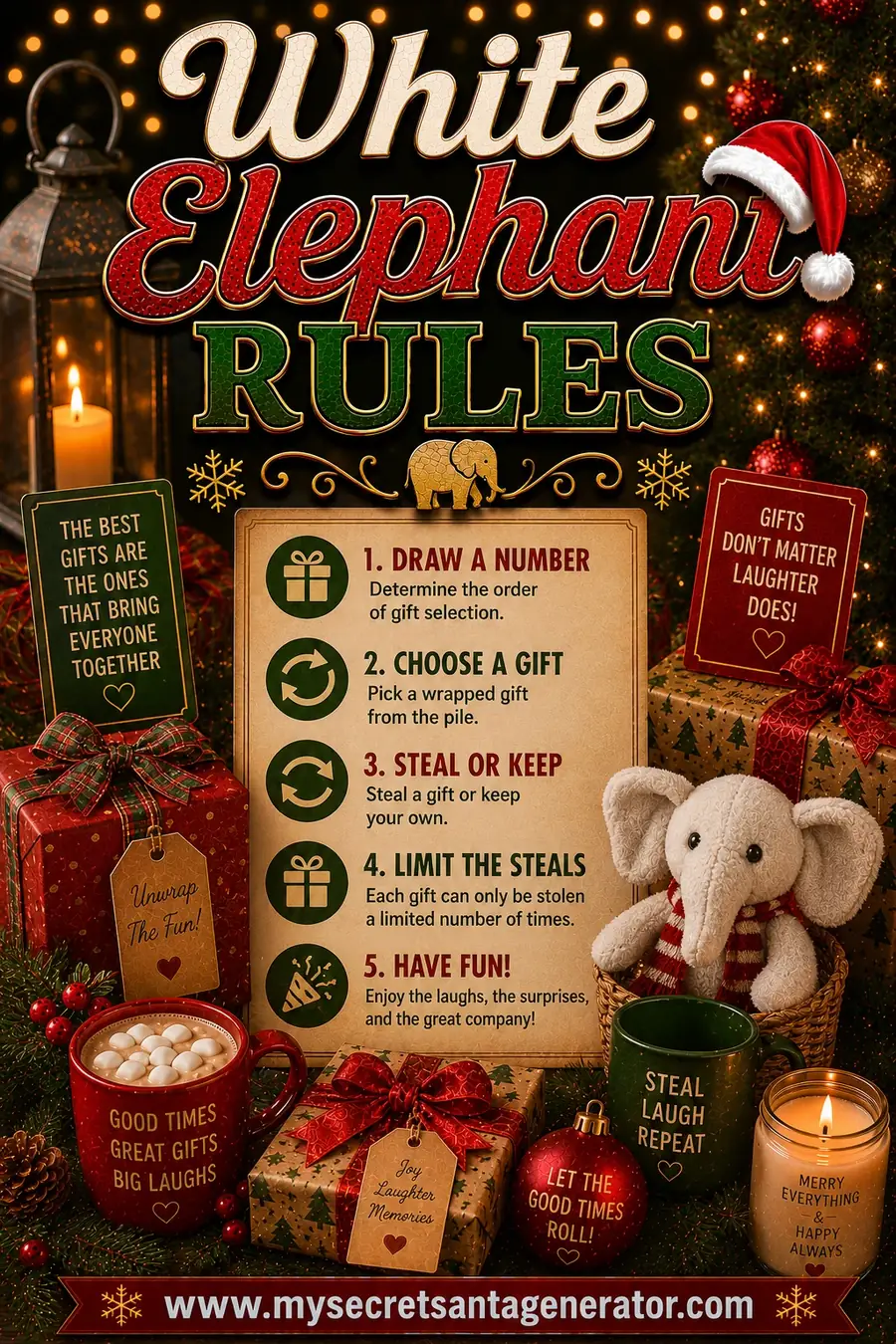
- Everyone brings one wrapped gift within the group's price limit (often $20 to $25).
- Gifts go in one pile, with no names on them.
- Everyone draws a number. That's your turn order.
- Player #1 opens a gift from the pile and shows it off.
- Each next player chooses: open a new gift, or steal an opened one.
- If your gift is stolen, you pick again: open a new one or steal from someone else (but not the one just taken from you).
- The game ends when every gift is open. Many groups let player #1 take one final swap at the end, since they never got to steal.
That's the heart of it. Every group has its own house rules, like a limit of three steals per gift. For the full step-by-step with every common rule, see our white elephant rules.
Draw turn numbers
Instead of folding paper numbers into a hat, type your guests' names below and tap draw. The names come out in a random order, and that's your turn order: the top name goes first.
🎲 Draw White Elephant Turn Numbers
Five sample names are already in, so tap draw to see how it works. The list comes out in a random order: the top name is #1, the next is #2 and so on. Then type your guests' names (one per line) and draw again.
Read the list out loud before the first gift is opened, so everyone knows when their turn is coming.
Why is it called white elephant?
Here's the story most people tell. Long ago in Siam (the country now called Thailand), a rare white elephant was a sacred animal and a symbol of royal power. According to the legend, when a king was unhappy with someone at court, he would "honor" that person with a white elephant. It sounds like a wonderful gift. The catch? The elephant couldn't be put to work or given away, and it needed huge amounts of food and care. Keeping it could ruin the owner.
Historians aren't sure this ever really happened, so think of it as a legend rather than proven history. Either way, the phrase stuck. In English, a "white elephant" came to mean something that costs more trouble than it's worth, or something you own but don't really want. Later, "white elephant sales" were rummage sales of things people no longer needed.
The party borrowed the name for the same idea: the gifts are a little silly, sometimes a little useless, and the real prize is the laughing. Today most groups mix funny gifts with genuinely nice ones, so the "white elephant" part is more about the spirit of the game than the gifts.
What is a white elephant gift?
It's the one gift you bring to the pile. A good one is something most people at the party would be happy to steal. That could be:
- Cozy: a fleece blanket, fuzzy socks, a mug with cocoa packets
- Useful: a phone charger, a small tool kit, a nice ice scraper
- Funny: a giant gummy bear, a toilet-paper-roll calendar, a singing fish
- Tasty: a box of cookies, popcorn, fancy hot sauce or a candy sampler
Keep it wrapped, keep it within the limit and keep it right for the crowd, especially if kids or coworkers are in the room. Need ideas? Our white elephant gift ideas are sorted by type and budget.
White elephant party ideas
- Pick a theme. "Something cozy," "something red" or "something you'd use in winter" makes shopping easier.
- Set out snacks first. Let people mingle for 30 minutes before the game. It runs better when everyone's settled.
- Use a big circle. Everyone needs to see each gift being opened. That's half the fun.
- Add one twist. Draw a twist rule from the card at the top before you start.
- Plan for leftovers. Bring one spare gift in case a guest forgets theirs.
- Take a group photo. Everyone holding their final gift makes a funny memory.
Twist rules to keep the game fresh
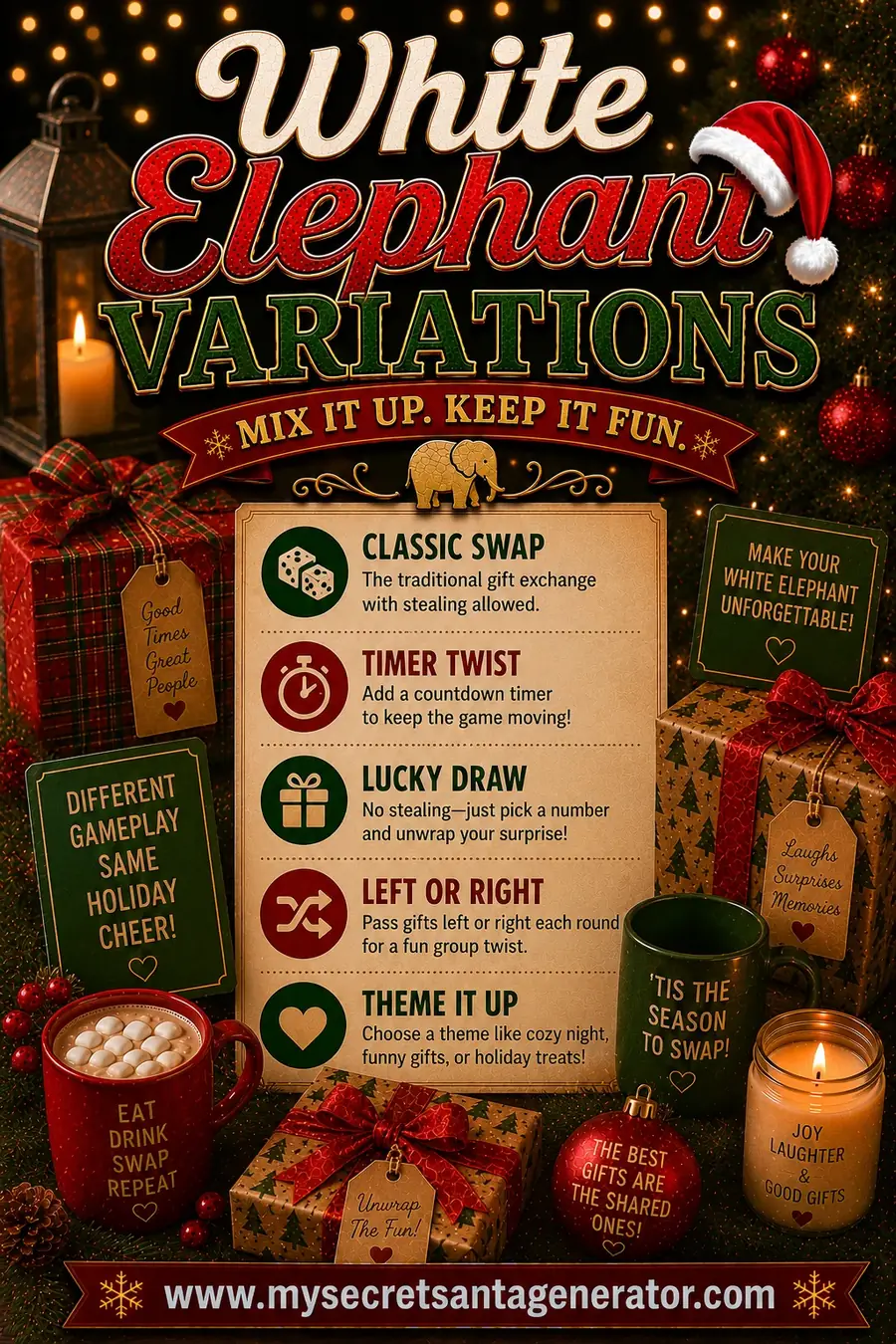
If your group does white elephant every year, a twist keeps it interesting. Pick one before you start, or tap Draw above for a random one.
| Twist rule | How it works |
|---|---|
| Three steals and it's frozen | After a gift has been stolen three times, it stays with its owner. |
| No steal-backs | You can't steal right back the gift that was just taken from you. |
| Last turn gets a free swap | Player #1 gets one final swap with anyone when the pile is empty. |
| Steal from your left only | You can only steal from the people sitting to your left. |
| Open it with mittens on | Each player unwraps wearing mittens or oven mitts. |
| Swap with the youngest player | At the end, the youngest player can trade with anyone once. |
| Unwrap without tearing | Gifts must be opened without ripping the paper. Good luck. |
| Everyone passes left | At the end, everyone passes their gift one seat to the left. |
| Describe it in three words | Before opening, guess what's inside in three words. |
| Guess who brought it | After opening, everyone guesses who brought the gift. |
For even more ways to play, see our white elephant rule variations.
White elephant vs Secret Santa: what's the difference?
People mix these up all the time. In Secret Santa, everyone draws one name ahead of time and buys a gift for that person. In white elephant, nobody shops for anyone in particular. Everyone brings one gift for the pile, and gifts can be stolen during the game. Secret Santa is more personal. White elephant is louder and sillier. For a side-by-side look, see white elephant vs Secret Santa.
Is white elephant the same as Yankee swap or Dirty Santa?
Pretty much. "Yankee swap" is a common name in New England, and "Dirty Santa" is used in parts of the South. The rules can differ a little from group to group, but the core idea is the same: one pile, numbered turns and stealing. Our Yankee swap rules cover that version.
Common mistakes at a white elephant party
- No price limit. One $5 gift next to a $50 one feels awkward. Set a limit and share it on the invite.
- No steal limit. Without one, a single popular gift can keep the game going for an hour.
- Gifts that don't fit the crowd. A gag gift that's funny with old friends may not land at the office or with kids.
- Explaining the rules after the first gift. Read the rules out loud before player #1 goes.
- Forgetting player #1. They never get to steal unless you give them a final swap.
Planning a regular name draw for the same party? The free Secret Santa generator draws names in seconds and sends everyone their match.
Frequently Asked Questions
What is a white elephant party?
It's a party built around a gift-swap game. Each guest brings one wrapped gift, everyone draws a number, and on your turn you either open a new gift or steal one that's already been opened. The fun is in the stealing, not the gifts.
Why is it called white elephant?
A commonly told legend says the kings of Siam (now Thailand) gave rare white elephants to people who had displeased them. The animal was an honor, but so costly to keep that it could ruin the owner. So a white elephant came to mean a gift that's more trouble than it's worth, and the party borrowed the name for its silly, sometimes useless gifts. Historians aren't sure the legend is true.
What is a white elephant gift?
It's the one wrapped gift you bring to the swap. It can be funny, useful or cozy. Most groups set a spending limit, often $20 to $25, and many say anything goes as long as it's wrapped and fits the crowd.
What's the difference between white elephant and Secret Santa?
In Secret Santa you draw one name and buy for that person. In white elephant nobody buys for anyone in particular: everyone brings one gift for the pile, and gifts can be stolen during the game.
How many people do you need for a white elephant party?
About 6 to 20 is the sweet spot. With fewer than six there isn't much stealing, and with more than 20 the game can run long, so many big groups split into two circles.